Whispering pool

A year ago, I realized that an obscure piece of local architecture had one of the oddest characteristics to be found in this area. Discussed on the main website on a page about Curiosities, it is our local whispering gallery.

The structure is actually a long–abandoned, century–old, swimming pool that is an easily overlooked feature of Kokanee Creek Provincial Park. It is accessed by going about 600 metres up the Kokanee Glacier Road and taking a short path into the woods on the north side of the road.

What I realized was that the empty pool’s elliptical shape enabled it to function as a whispering gallery: a person located at one of the two foci could hold a quiet conversation with someone at the other.

Yesterday, I showed it to visitors. One person knelt at each focus: about 80 centemetres from each end of the twelve–metre axis. The two people were easily able to whisper back and forth despite the fact that, standing halfway between, I could hear neither. Really neat.

Trying out Kokanee Creek Park’s strangest feature: a whispering pool.

Posted in history, scenes | Comments Off on Whispering pool

Condylostylid

If one were to judge all flies by the few baddies, such as the house fly and mosquito, we would miss out on the delightful ones in the yard and woods. Many folks take pleasure in watching the many species of hover flies go about their rounds. Indeed, in the U.K. there are hover fly watchers, just as there are bird watchers.

This posting is not about a hover fly, but another rather friendly group: the Long–legged Fly (Condylostylus sp.), generally also known as the Condylostylid Fly. It is tiny usually being less than 5 millimetres long; it has long legs; it is the gardner’s friend as it goes about devouring aphids and silverfish; it is fairly easy to approach; but most of all, it is amazingly colourful with metalic green, blue, and gold. There seems to be more the one species around here as I have seen them with both red eyes and green eyes.

Below are two pictures, one with greenish eyes taken this summer, and one with reddish eyes taken two years ago. The Condylostylid Fly will visit flowers for nectar, but I usually see it on leaves, where I assume it is hunting.

Posted in bugs | Comments Off on Condylostylid

Kestrel bonanza

Sunday, I saw my first kestrel—my first ever—and not just one, but two chicks and three adults. I owe it all to Derek Kite. I have never been able to find kestrels on my own, and certainly wouldn’t have found these ones. Yet, only a few hundred meters from a road, Derek had found a birch snag with kestrel chicks peering out. He took me there. We sat on the ground at a discrete distance and watched for a few hours. The nine pictures below offer a taste of the morning.

Sometimes one, sometimes two chicks peered out of an opening high on the birch snag.

If chicks are there, adults cannot be far away. On an adjacent snag sits a female who has captured a June beetle,

that she then delivers to the nest,

for a happy chick to eat.

An adult male captures a smaller bird, eats the tasty brains,

then delivers the rest of it to the nest. (My most satisfying image of the day).

For reasons that are unclear, another male (one with a ragged tail) also visits the nest. One of the males might be an elder sibling helping out. Who knows?

A final shot of an adult male at the nest hole.

All in all, a superb morning; thank you Derek.

Posted in birds | 5 Comments

Peeping Tom, er, bird

I am used to birds colliding with my windows; I am used to birds challenging their reflections in my windows; but, I am not used to birds sitting on an outside window sill and merely peering inside. But, this seems to be what a Yellow–rumped Warbler did, and not at just one window but two of them.

The Yellow–rumped Warbler is a fairly common bird around here in the spring and summer, and for that matter a delightfully colourful addition to the neighbourhood. (At first I thought I could specify the sex of this bird, but it is not clear).

A Yellow–rumped Warbler peeks in one window,

and then hops onto a bench before moving on to another window to peek in the house again.

Posted in birds | 2 Comments

Honey bee mimic

The ancients believed that (adult) honey bees could be produced from dead meat. References to this are found in Hebrew and Roman literature. How could this strange belief have arisen? The answer is simple and found to this day in most summer gardens.

The honey bee has a mimic: the drone fly.

It is not uncommon for various species of flies to mimic a bee or wasp. Being the look-alike of a stinging insect confers some protection from predators such as birds. Macrophotography easily enables us to tell the flies from the bees, but, when these insects are seen moving rapidly or in the distance, the differences are apparent to neither birds nor ancients. While adult honey bees emerge from larva in a hive, adult drone flies often emerge from maggots in decaying flesh. It was the honey bee mimic the ancients would have seen emerging from dead meat, not the honey bee.

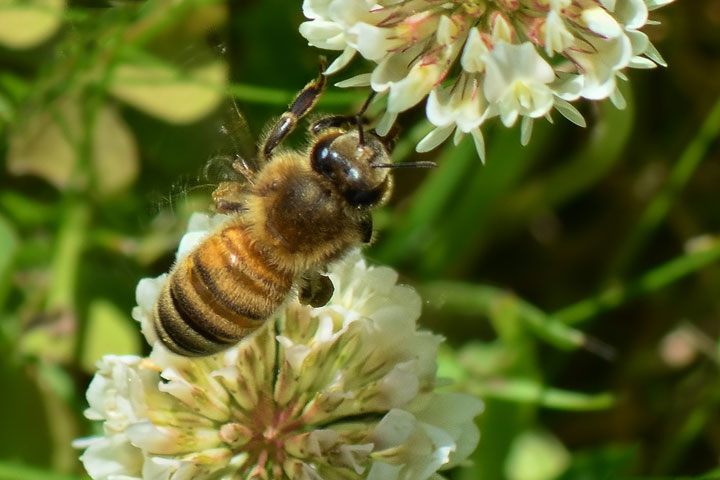
The first picture shows a honey bee (Apis mellifera) collecting pollen from clover. (Why I have honey bees in my yard is unclear. Are they feral or does a neighbour keep hives?) The bee has long antennae, small eyes, and a distinct waist between the thorax and abdomen. It also has four wings, but that is more difficult to spot.

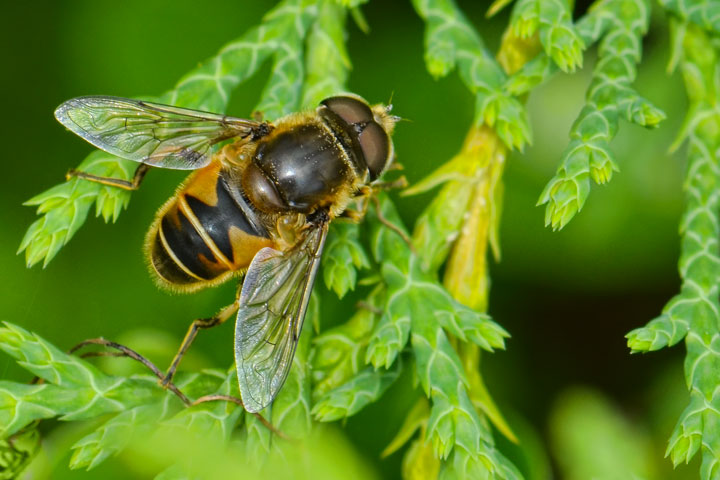
The second picture shows the drone fly (Eristalis tenax). It has short antennae, large eyes (this one is a male, so the eyes nearly touch), and no waist between thorax and abdomen. It also has only two wings.

Each of these insects is a European import that has become well established across North America.

A honey bee forages for pollen. 

Although shown here on a cedar bough, the drone fly is a pollinator and is frequently found on flowers. The hourglass pattern on the abdomen of this fly is characteristic. It neither stings nor bites so its primary protection is that it looks like something with better defences. 

Posted in bugs | Comments Off on Honey bee mimic

Osprey flyby

I have commented a few times that ospreys of the West Arm are in retreat this summer: Ospreys’ annus horribilis, Happy herons. Of course, that doesn’t mean that they have all vanished, just that nesting has been remarkably poor. There are a few around.

Here is an osprey seen two days ago in the lakelet between Kokanee Creek Park and the Harrop ferry.

Posted in bugs | 2 Comments

European skipper

The European skipper is an invasive species. It was accidentally introduced into Ontario in 1910 and has since spread westward. That being said, one has to admit that invasive isn’t a bad word. This colourful butterfly does not seem to have displaced anything, but merely added to the richness of the fauna in the neighbourhood.

Here are two of the many European Skippers seen this afternoon in a field of tall grass and wildflowers.

Posted in bugs | Comments Off on European skipper

Swallows two

I am so used to seeing Tree Swallows that I sometimes don’t even notice that some other swallows may have turned up.

I was watching the resident heron today (last picture), and swallows kept flitting by. Oh well, take a few pictures. But, they weren’t tree swallows. The first was a Northern Rough–winged Swallow, the second…, well, that was a problem. While it looked like a Violet-green Swallow, the throat and colours seemed wrong. The problem seems twofold: it is a juvenile and hasn’t yet attained full adult plumage. And Carol Pettigrew of Beaks (bird rescue) tells me that the sooty feathers are a result of malnutrition—it has had an inadequate supply of bugs.

A Northern Rough–winged Swallow.

A young malnourished Violet-green Swallow has sooty feathers.

And another picture of our resident Great Blue Heron.

Posted in birds | 3 Comments

Cat & mouse

Or more to the point: a Bobcat and a Long-tailed Vole.

If you want to see wildlife where it lives, you must spend time in the wild. So it is that, once again, the indefatigable Doug Thorburn managed superb wildlife images (three below), this time of a Bobcat hunting in the south Selkirks.

A Bobcat peers out of the brush.

It approaches.

And shows off its catch: a vole.

Pictures used with permission.

Posted in mammals | 4 Comments

1, 8, now 9 chicks

Previously, I showed pictures of a mother Common Merganser wandering by with one chick; later eight chicks came by. Today in the rain, another momma visited with nine chicks (two pictures below). At times they did the delightful merganser–chick thing of hitching a ride on mother’s back.

So, is it too much to hope for a dozen next time?

Posted in birds | 2 Comments