It seems that 2011 is an annus horribilis for ospreys along the West Arm of Kootenay Lake. Normally there might be 20 or 30 nesting pairs on the stretch of water between Balfour and Nelson (there is variation: in 2009 there were 17). In late May this year, a survey by Janice Arndt and Elaine Moore found only three nests (two of which were inland). In early June, I searched a stretch of the Arm and found no osprey nests where there had been many in the past.
In early May, many ospreys had arrived at the Lake and started housekeeping just as they had done in other years. But by late May most nests were gone. What happened? We think we know, but would appreciate further insights.
High winds destroy nests
I had been monitoring a nest in front of my place and had made quite a few postings about it. I returned from a field trip on May 14 to find the nest gone and adjacent wind damage. Those birds have not returned. Janice Arndt monitored an osprey nest on a dolphin seen from her home. It was destroyed by high winds on May 13 and 14. Charlie Zinkan watched the nest at Sunshine Bay. Again, it was destroyed by high winds (but those ospreys seem to be trying to rebuild).
It seems likely that many nests along the West Arm were destroyed by high winds at the same time. A promising start had been blown away. Can anyone add any further evidence?
Ospreys at Sunshine Bay are trying to rebuild after high winds destroyed the first nest, but it seems that most other ospreys have just given up (picture taken June 13, 2011). 




 The first question is: As the snow on the pillow melts in the spring, at what (water equivalent) depth does the Lake level typically crest? After a few years of monitoring, it seems the value is about 700 mm (with some variation).


Do, but don’t learn
Today there was a book launching in Nelson in a children’s series entitled: Learn and Do. The book, called Let’s Plant a Flower, is aimed at small children and encourages them to go outdoors and do just that. What can I say, this is a worthy objective nicely presented.
Yet, I have a problem with it. Certainly, I am in favour of encouraging children to go outside and interact with nature. But, while the book increases a child’s sensitivity to one aspect of nature (plants), it offers the child nonsense about another (weather). To see this, you have to visit the sample pages for the book on the website for Let’s Plant a Flower, and turn a couple of pages (click on the lower right corner of a page). Presented is an impossible rainbow—one that cannot happen in the natural world.
Red is on the outside; blue is on the inside.
The drawing displays a number of unnatural features; I will mention only two.
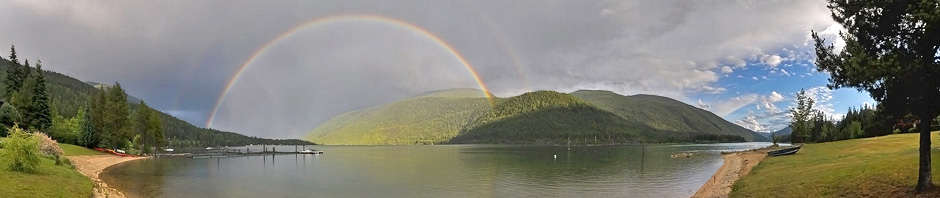
First, the colours in the book’s illustration are presented backwards. In nature, the colour order of the (primary) rainbow is red on the outside, blue on the inside. Nature is not capricious on this point. See the picture to the right, the header for this blog, or for that matter, any rainbow picture.
The observer's shadow is the centre of the bow; the Sun is on the other side of the sky.
Second, the Sun in the book’s illustration is positioned along the bow as if it were a buckle on a belt. In reality, if you look at a rainbow, the shadow of your head is the centre of the circular bow and the Sun is at your back. The Sun and the rainbow do not appear on the same side of the sky. That is just the way nature behaves.
So what? Isn’t the book’s illustration merely an example of artistic licence? Possibly, and I often thoroughly enjoy artistic licence, examples being the works of, say, Picasso or Escher. But I wouldn’t want my surgeon to have based his knowledge of anatomy on the works of Pablo Picasso, nor would I want my building contractor to have learned construction through the works of M.C. Escher. I would like such people to be grounded in reality.
In like manner, I wouldn’t want my children to learn about nature from this book.