California quail


The California Quail does not belong here. But, this one was seen just west of Nelson yesterday.

The California Quail was seeded in the Okanagan for hunting in the nineteenth century, but it is rarely seen here. It is only my second sighting. Nine years ago I saw one in Waneta. As it generally avoids mountains and forested regions, the Kootenays are not particularly suitable for it.

A California Quail seen at Taghum.


Posted in birds | 1 Comment

May goulash


This is a small collection of pictures taken this May which didn’t have a posting of their own. Well in this case, it is also just a few shots while trying out a camera.

One of my first shots was a close view of an osprey rushing by in flight. 

A tranquil shot featured four painted turtles on a loafing log.

A yellow-bellied marmot constantly called and raised its tail. I thought it sought a partner, but none appeared. When I looked at the pictures, I realized its problem: constipation. 

For a while I watched a female Rufous Hummingbird and separately a male Black-chinned Hummingbird (another one is shown here). But, these two were all that appeared.

Finally, a male Rufous turned up. It was cloudy so the iridescent red gorget showed rarely.

However, now and then, the gorget was stunning.


Posted in birds, herptiles | 4 Comments

Hummingbirds, plus


Hummingbirds have been seen recently around the region. I have seen a female Rufous Hummingbird for about a week. And of late, a male Black-chinned Hummingbird has arrived.

During the hummingbird season, we get three different species: rufous, black-chinned, and calliope. Well, on rare occasions there has been seen a fourth: the Anna’s. The latter is seen at the Coast and in 2017 was made Vancouver’s official bird, but it is exceeding rare here. So we can count on seeing three species here, but as the sexes differ, there are six forms. I have yet to spot all six in one season.

Nevertheless, while watching the black-chinned, a different visitor stopped by.

A female Rufous Hummingbird flies by.

After a few days, a male Black-chinned Hummingbird frequently appeared and on one occasion it flashed its iridescent purple gorget. 

While I was watching the black-chinned, a juvenile raccoon came around and begged.


Posted in birds, mammals | 4 Comments

Eagle’s lost nest


Thursday evening (May 16, 2024) a Bald Eagle’s huge nest came down when the top part of the tree blew off in high wind. The two chicks in the nest were killed in the fall to the ground far below as they were just sprouting feathers and still unable to fly. Their two parents survived because they could fly.

The nest was at Fraser’s Landing beside Cherry Bay on the west arm of Kootenay Lake. The nest had been a favourite of mine for a few years. Each year, I photographed the parents and chicks and watched the nest grow larger and larger. What the surviving parents do now is yet to be seen, but they may try to make another nest nearby.

A discussion of the problem faced by eagle parents follows shots from the last few days.

Less than two weeks before the wind, I had taken this shot of the mother on the nest. The two chicks are still too small to be seen above the brim of the nest, but what is evident is that the nest itself is gargantuan.

This was taken a day and a half after the top of the tree and the nest came down in the strong wind. The top of the tree and the debris of the nest is on the ground. The remaining lower part of the tree is standing on the right,

A day and a half after the wind, the two parents are in an adjacent tree. The male (right) has just flown in with a fish. They must now decided what to do. Photo by Cynthia Fraser.

Now, some reflections on the situation. Eagles like to find a tall largely bare tree (this one was dead) near the water. They started the nest maybe a half-dozen years ago. Each year they added to it, until it was big and heavy enough to bring down the tree in a strong wind. The question is: why was the nest allowed to become so big and heavy that it collapsed the tree and killed their chicks?

The simple answer seems to be parasites. Bald Eagles are at the top of their food chain and there are few other animals that catch them and eat them. But parasites are very small and are found on the tree and in their food. It seems that protecting themselves and their chicks from parasites prompts them to add a new fresh clean layer atop the nest each year. So, the nest gets bigger and bigger and this ultimately almost always causes it to fall in a strong wind. So, their tactic of adding sanitized layers makes sense. Unfortunately, they wait until the nest makes the tree fall rather that quitting after, say four or five years, and at that time building a replacement nest.

To celebrate this tree, here are two pictures from the past.

Both parents and two small chicks in the nest from 2022.

One parent and two larger chicks in the nest from 2021.

This is not the only eagle nest I have watched come and go. But, I want to mention one other dead tree that was visited regularly by Turkey Vultures until it fell down. Alas, as far as I know, it hasn’t been replaced.

For some time, a tree near Red Fish Creek was used by Turkey Vultures to warm their wings in the sunlight. But, these birds did nothing to bring the tree down; it just fell when there was no wind.


Posted in birds, commentary | 2 Comments

May miscellaneous


I went looking for something else, but instead found, well, many other things.

On a pond by the river, there was a loafing log with 14 painted turtles in three sizes. The mature females are the largest and there were 2 of them. Next in size were the males (5 of them), and then there were the hatchlings (7 of them). The painted turtles owe their name to the patterns on their ventral (under) side. Although painted turtles are known across the continent, only the western ones actually have patterned ventral surfaces. So, our turtles do, but to see it, you have to turn them over.

This is a male mule deer. You can see its recently started antlers, which will grow to combat size by the end of the summer. The most frequently seen deer at the valley bottom is the female white tail. The mule deer is found at higher altitudes. This one was about 1200 meters above sea level.

It is the time to see recently hatched chicks. These 11 are Mallards with their mommy.

The western trillium is found here, but is not nearly as common as many other flowers. As the name suggests, it is patterned on three: both petals and leaves. I noticed that it was reasonably abundant on the shady side of the road, with none on the other side. Well, it does prefer the shade. It is also spread by ants which love to collect and eat the shell casings but then scatter the seeds. Older flowers fade to a pinky purple. 

The Columbian ground squirrel is common in many fields in the West. However, normally, most parts of it are hidden in the grass. This view of it standing erect on a gravel road was appreciated.

This female Ruffed Grouse was in the back country forest and was difficult to photograph as it kept running back and forth in the bushes. It finally dawned on me that it was reacting to my presence and was trying to persuade me to follow it away from its nest. With this realization, I left and gave it the satisfaction of chasing me off.


Posted in birds, herptiles, mammals, wildflowers | 4 Comments

Two shorebirds


Killdeers, I am used to seeing, as they migrate to this region earlier that other shorebirds. But now I was expecting to see the Spotted Sandpiper. But, no, there was a Solitary Sandpiper, probably on its way north. It spent a long time feeding near the shore.

A Solitary Sandpiper feeds in the shallows. (It has a leaf temporarily caught on its foot.)

But, we did see a Killdeer — indeed there were two of them mating. She has lifted her tail and he has lowered his to allow their cloaca to make contact. Photo by Cynthia Fraser.


Posted in birds | 1 Comment

Sage Thrasher


Wander around enough, and you will sooner or later encounter something offbeat. That is what happened yesterday morning when I found a Sage Thrasher.

The Sage Thrasher is a western bird that is one of the rarest birds in Canada and is Red Listed in BC (candidate for extirpation). It is known in very small numbers in the southern Okanagan, but is largely unknown in this forested region. Apparently in the Okanagan, it is closely associated with remnant sagebrush grasslands, but the loss of this habitat due to development seems to have produced increasing losses in these birds.

The Sage Thasher is about the size of a robin.

It uses undulating flight, where part of the time, its wings are beside its body.

The Sage Thrasher does find some insects for food.


Posted in birds | 2 Comments

Spring arrives


The temperature now rises above freezing day and night at the bottom of the valleys. The trees begin to bloom, and skunk cabbage sprouts in moist areas. Birds mate and build nests. Migrants arrive and some pass northward. This is but a sampling.

A permanent resident, the Song Sparrow, gathers materials for a nest.

At this time of the year, most of these tiny frenetic birds, the Ruby-crowned Kinglet, pass right through on their way north to breed. This one is a female and it lacks the ruby crown. Indeed, even the male only shows the crown occasionally.

Turkeys are now a staple of this area, but their annual mating is now largely past. However, some males are still in display. Here is a spread tail from behind.

And here is the male turkey’s head and neck.

The Townsend’s Solitaire will soon be heading north to breed.

You know it is spring when the Mountain Bluebirds come through. This is a male.

And this is a female Mountain Bluebird.

The Osprey have arrived and are beginning to build nests. They will now be a staple of the Lake through September.

This is the season of flowers and one of the first is the glacier lily.

Usually, the first orchid to bloom is the fairy slipper in May. However, these small beginnings were found late April. This one with fake yellow anthers is an eastern variety. 

And the one with fake white anthers is a western variety. We get both.

The mourning cloak is one of the first large butterflies to appear in the spring as it is one of the few that overwinters as an adult.

Robins have arrived in large numbers and will be with us through October.

A chipmunk hides in the brush and eats.

Turkey Vultures typically arrive from the south in March and are with us until October.

The Snow Goose is seen in large numbers at the Coast, but not here. We are far off the bird’s usual migratory track. Only occasionally,  one or two pass through on migration.

You know that spring is here when the Red-winged Blackbird arrives. This one is flying through some cattails.

I have seen a good many waterfowl pairing up, but these Canada Geese are the first chicks I have seen.


Posted in birds, bugs, mammals, wildflowers | 4 Comments

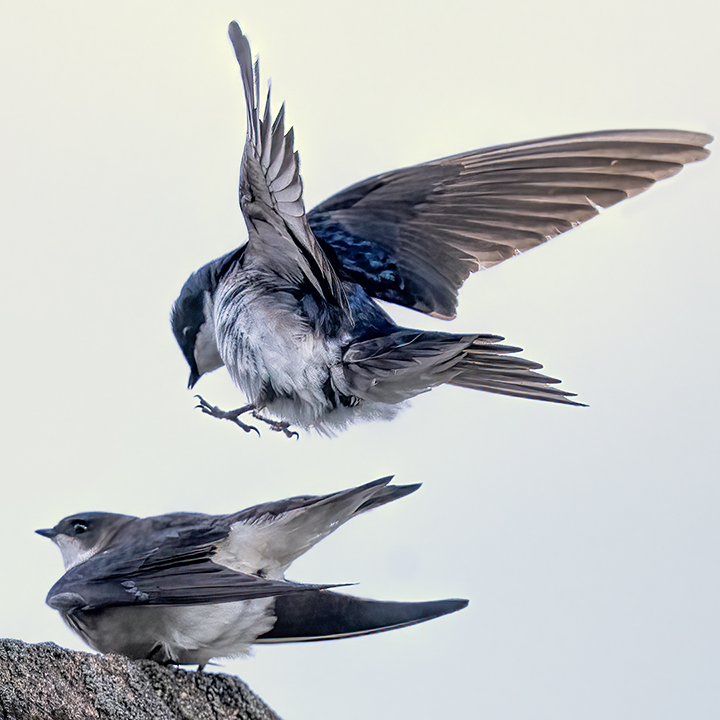
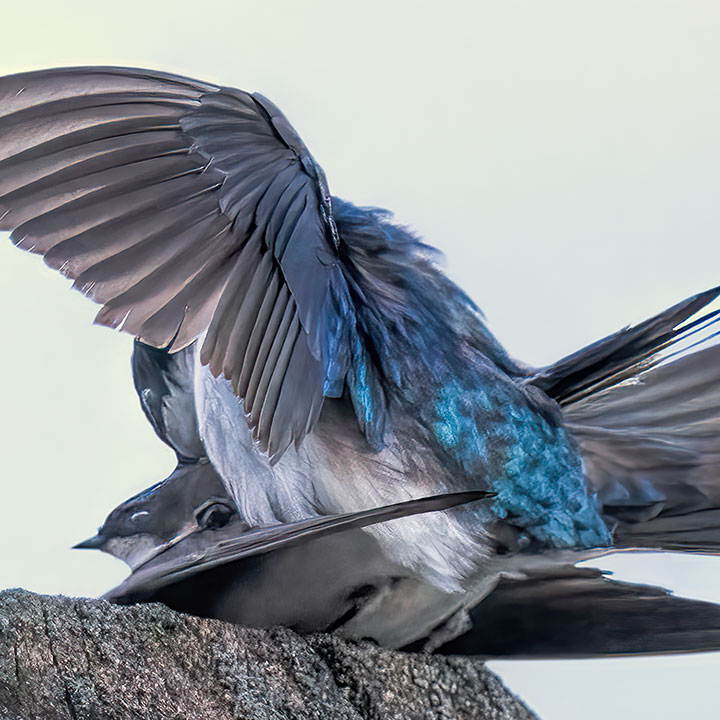
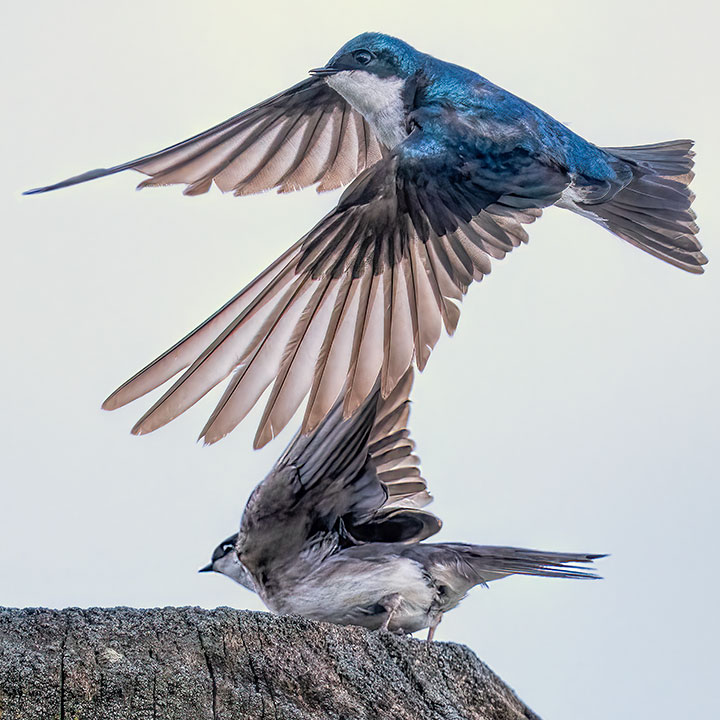
Wild Turkey mating


This posting either has two pictures or nine pictures depending upon your sensitivity.

The survival of a species depends upon two things: food and reproduction. This is about reproduction.

This posting is also about Wild Turkeys, a bird that was unknown in the interior of BC only about 50 years ago. At the urging of hunters south of the border, they were planted in Washington and Oregon 50 to 60 years ago. They soon crept across the border. First here in only small numbers, they are now rather common and are described by eBird as exotic, but naturalized for the Central Kootenay region.

A vast majority of birds form pair bonds, either for a season or for life. Some adopt seasonal or breeding plumage; some do delightful male-female courting behaviours before they mate. However, very few in this region alter their appearance the way Wild Turkeys do. Think of swans. They may have beautiful courtship behaviours, but neither the male nor female bird drastically alters its appearance before they mate.

Birds that do not form a pair bond often have a noticeable courtship display and sometimes it is truly outlandish, and bizarre. It is to this latter group (not forming pair bonds) that the Wild Turkey belongs. Indeed, the sexual display of the male Wild Turkey is perhaps the most striking one in North America. 

This is about the mating of the Wild Turkey. You can view the first two pictures and then stop.

This male Wild Turkey is in its full courtship display. It fans its tails, and puffs body feathers. Its featherless head is red, white, and blue with a snood (long red flesh that extends from between the eyes), caruncles (lumpy fleshy folds that wrap around the base of their neck like a white or red scarf weighed down by three bulbous masses), wattles (a thin fold of skin beneath their chins), and a beard (hairs extending from breast). They also strut, gobble, and drum their wings against their bodies.

When they mate, the female lifts its tail and the male lowers its tail until the cloacae come in contact so semen can be exchanged. In this picture most of the feathers belong to the male. Only the female’s head and a few wing feathers are visible. Photo by Cynthia Fraser.
 

OK, that is end of the first two pictures. What follows are more detailed photos of a separate mating act taken earlier the same morning.

When a female’s pheromones have arisen sufficiently, she will accept the advances of the male and will crouch down in front of him. Some of these shots were taken through tree branches which clutter the pictures. Note, the male’s caruncles are white at this point. They will become red by the end.

He then climbs on top of her.

The male stands atop the female. There then ensues a lifting and lowering of the tails, the object being for the male to bring his cloaca in contact with her cloaca. 

Here, the female has lifted her tail and has revealed her cloaca.

Mating: the male lowers his tail and the two cloaca touch. He ejects semen from his cloaca into her cloaca.

The male climbs off, but briefly you can see the semen on her cloaca (along with some running down from it).

They separate and probably have nothing further to do with each other. Notice that the male’s caruncles which were white at the beginning, have now turned red. 


Posted in birds | 3 Comments

Nesting on wooden pilings


Wooden pilings are used by a few species for breeding. Now that these pilings are on their way out, how will this change? Metal pilings are the new standard.

This is the second of a two part series on wooden pilings. The first was on perchers. This one is on breeders. There are only a few birds that have adopted this fairly recent (and short-lived) innovation for their their breeding, but some have adopted it to the near exclusion of other places. No longer content with trees near the water, they now use wooden pilings that sit in Kootenay Lake. In perhaps a half century, some will need to return to the forest. It is noted that these nesters are also perchers.

The dominant birds using the wooden pilings for breeding are the Osprey, the Northern Flicker, and, to a lesser extent, the Tree Swallow. A few others use them occasionally (e.g.,  Starling). Of all of these, the Osprey seems most assured of some continuity.

The Northern Flicker is a permanent resident, although their numbers do go up during the migration of other flickers north and south. This flicker is a woodpecker which digs cavities in the wooden pilings in which it, and others, nest. It was noted earlier that nearly all the cavities face the land, presumably as a mechanism to enable it to watch for land predators. This is a tactic that does not seem to have an analogue among flickers that breed on land, so how it was quickly adopted when our flickers chose wooden pilings is unclear. Almost every wooden piling on the lake has at least one flicker cavity.

The Northern Flicker has excavated many nest cavities in the wooden pilings around this lake. Here, a father is seen feeding ant’s eggs to its chick. Although carved by flickers, the cavities are extensively used by other birds such as the Tree Swallow.

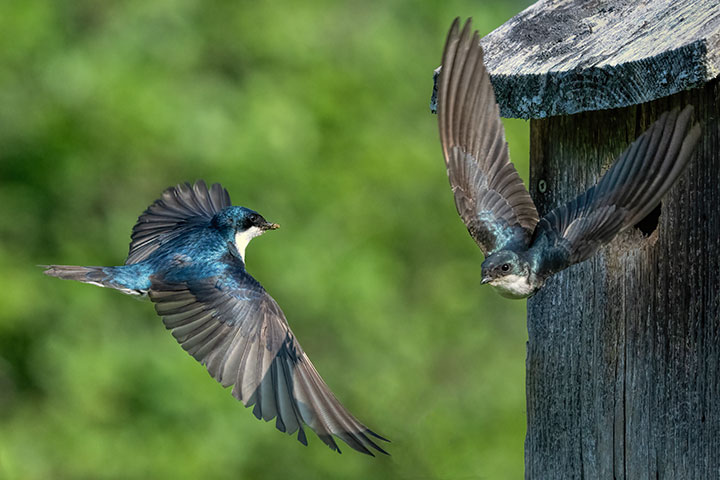
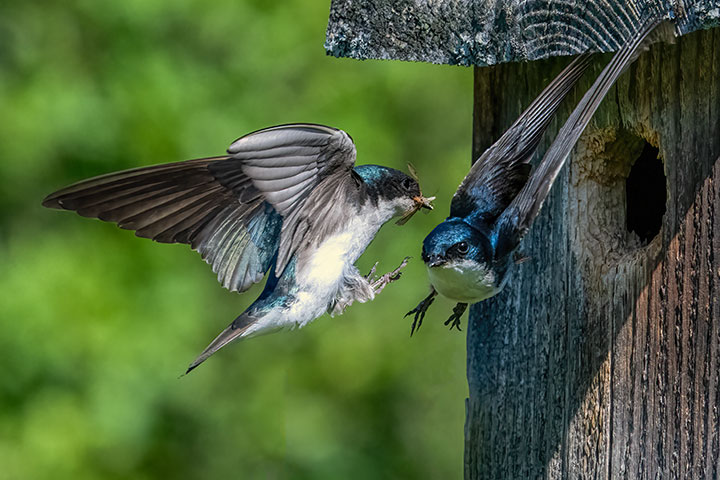
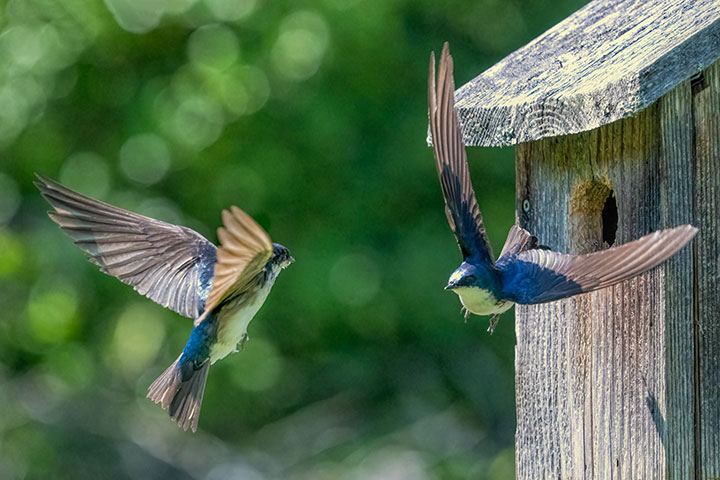
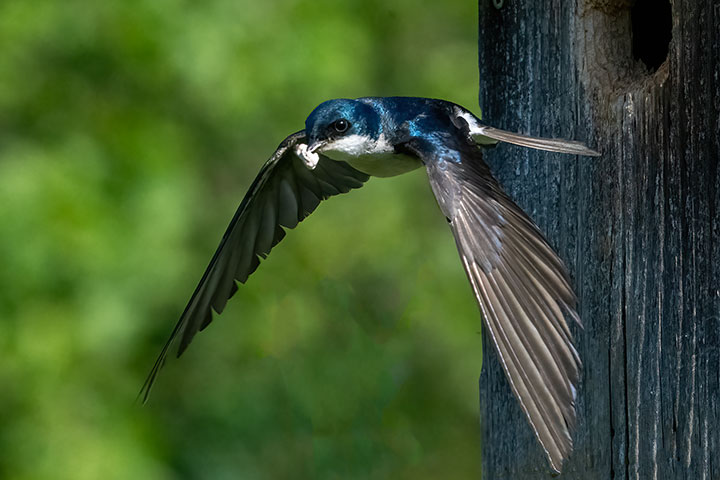
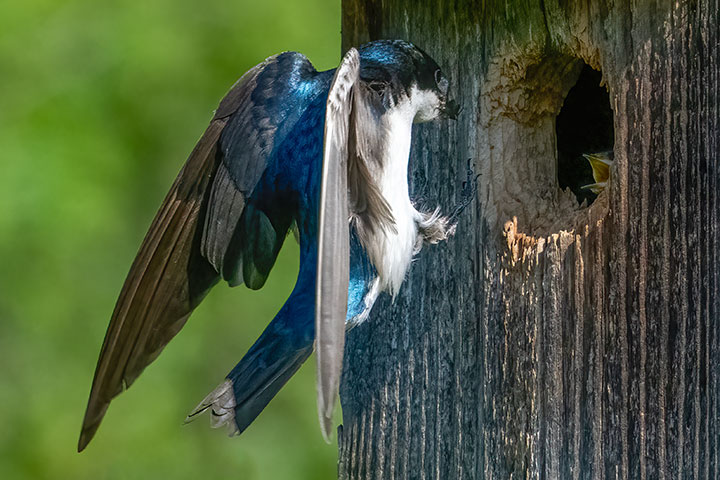
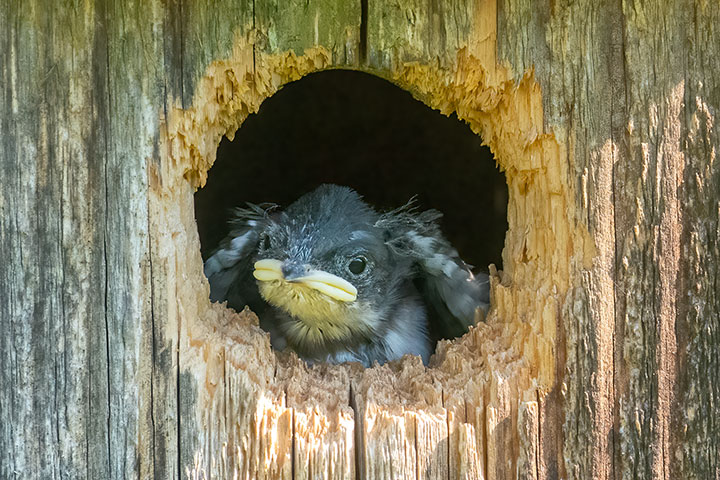
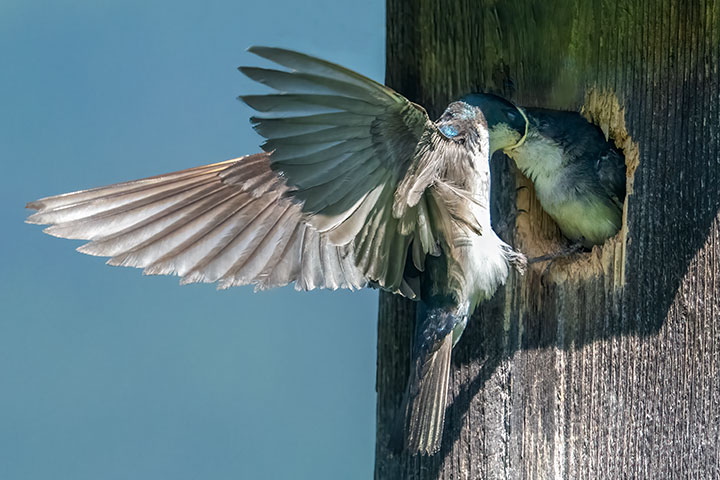
While a few other birds use flicker cavities, the dominant one seems to be the Tree Swallow. Here a father is bringing food to his chicks, each of which has its mouth open to accept it. However, since the Tree Swallow also regularly breeds elsewhere, a loss of wooden pilings is not expected to bother it significantly.

Ospreys are now the dominant breeder on wooden pilings. At earlier times, they chose trees beside the lake, although ones that usually were not quite so precarious as the one shown in this 1887 illustration. In modern times I have only seen a few couples nest in a tree, but now they almost exclusively nest on wooden pilings, dolphins, or special lake-side poles erected for them.

My earliest knowledge of ospreys nesting on wooden pilings comes from Troup. I don’t know when these had been put in, but pictures reveal that they were not there in the mid-1890s and were in place in 1929. In the mid-1940s, I summered right across the lake from Troup and I recall my uncle talking (in dismay) about someone setting the pilings on fire so as to kill the birds nesting on them. Apparently the arsonist’s logic was that the ospreys caught and ate fish, and, not liking the competition, he wanted to catch those fish for himself. Apart from the cruelty involved, his logic was flawed in that ospreys do not generally catch the same fish as those preferred by people. These pilings still show the signs of having been burnt (photo from 2005). However, it is clear that, by the 1940s,  ospreys were building nests on the fairly newly established pilings.

I don’t know when Ospreys began to build nests on dolphins (as distinct fr0m on isolated pilings), but it was probably in the 1960s. In the early 1970s, the number of Ospreys around Kootenay Lake began to increase, and many of these magnificent birds chose the dolphins as a nesting site. Now, an Osprey nest is a rather substantial structure, and when built at the top of a dolphin, it engulfed the light rendering it useless. Although at first the government would remove the nest to reveal the light, they soon changed tactics. They accepted a suggestion by Bob Denison that platforms be added above the light. Since his summer cottage was at Atbara (at the Nine-mile narrows), the dolphin there was the first to have this addition (which he put up himself). These platforms now characterize all dolphins and most play host to Osprey nests and Ospreys. This is the platform on the top of the Nine-mile dolphin at Atbara. Indeed, this practice of building a nesting place for the osprey has gone further than dolphins now. The power company and also private individuals have erected nesting platforms on poles placed near the lake which the ospreys have used. 

While I found I do not have a satisfactory shot of a constructed nest platform installed solely for the osprey, I do have a shot of two (full sized) chicks that had just flown from one while their parent watched from above. We can tell these are chicks because of their orangish eyes and their white-flecked wings.

The osprey’s preference for nests on or beside the lake is driven by its food: it catches fish.

This view of a nest on a wooden piling is of the father osprey bringing a fish to his family. There are three chicks (white spotted wings) and his partner (plain brown wings). When the wooden pilings vanish, the osprey will be likely be fine; it will still have trees and erected platforms on pilings and the dolphins, all in or close to the water.

An advantage of the wooden pilings is that they are out in the water and so free from land predators. This, of course, changes when Kootenay Lake water levels are low during the spring, but then that is not the nesting period. I have assumed that the main land predators of concern would be raccoons. But the squirrel is the only land predator I have thus far seen attacking a nest cavity. In fact, wooden pilings have been a particularly safe place for a nest cavity. Metal pilings will certainly bring advantages to people, but the safe perch and nest will be lost.

As a digression, I note that I have not covered all of the nesters to be found on a wooden piling. There are others. Consider this deer fly laying eggs on a piling. Deer flies were seen laying near the same spot on two separate years.

The eventual loss of the wooden pilings will be a disappointment for the ardent nature observer, but the animals will adjust. Probably the greatest loser will be the Northern Flicker who found a largely predator-free place to nest. So here is another shot, this one of the mother feeding its two chicks.


Posted in birds, bugs, commentary | 5 Comments