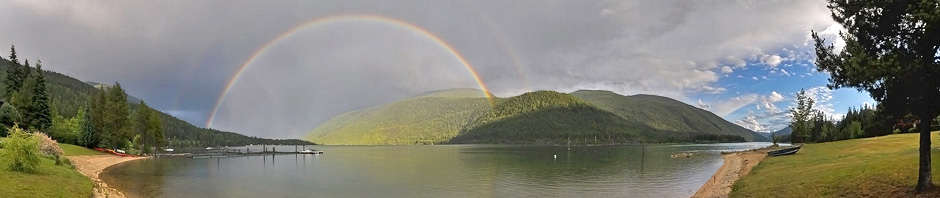
Snow falls off trees (move cursor over image; wait; move cursor off image; repeat).

Snow falls off trees (move cursor over image; wait; move cursor off image; repeat).
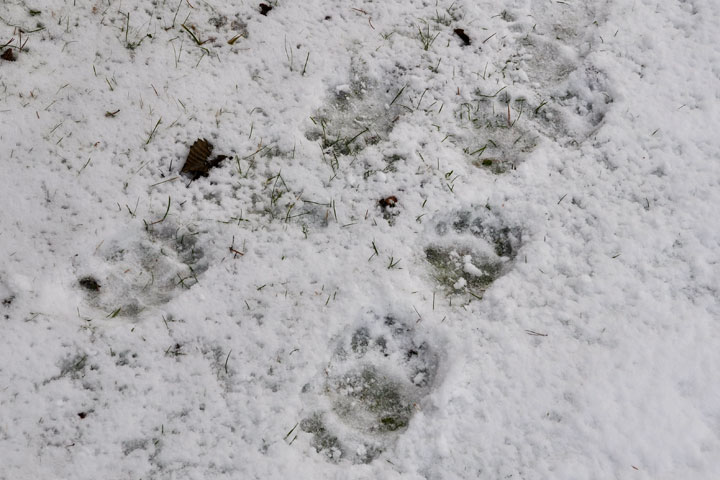
At the north end of the Lake, a friend put his bird feeder out again yesterday, thinking that the bears have now retreated for the winter. Yet, among the visitors to my snow–covered yard overnight was a bear (tracks below). So, I checked some earlier images and I have seen bear tracks in the snow in my yard into the second week in December. Nevertheless, last night’s bear did not discover my bird feeder.
Bears are with us yet.
The Kootenay-Lake Website offers a discussion and more pictures of local black bears and of tracks in the snow.
Black bear tracks in the snow under a tree where the snow isn’t deep.
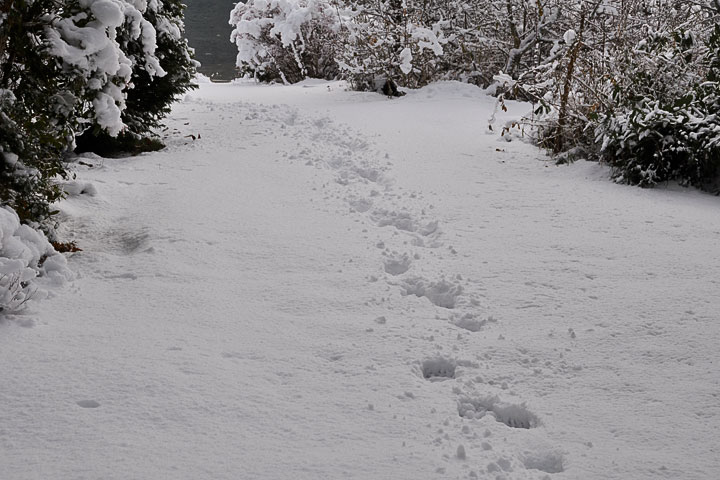
From there the bear tracks continue toward the Lake.
The outbreak of cold air following a cold front set the stage for today’s events. the Lake had:
This morning’s steam fog was as grand as one gets; the steam devil (below) was nice but not as grand as those of last December (but, then the season is still young). The sun dog was almost as nice as any I have seen around the Lake, especially as a portion of the parhelic circle extended from it to the left (see the discussion under haloes).
All in all, a lovely brisk morning for watching the Lake.
Steam fog over the Lake as seen from Duhamel (Nelson is in the background).

An acceptable, but not superb, steam devil (rising out of the steam fog) at Crescent Bay.
A sun dog and parhelic circle seen from Crescent Bay (with steam fog below).

Today, as the temperature hovered around -7°C and the visibility over the Lake dropped to zero in blowing snow (first picture), I was visited by—gulp—a wasp (second picture).
The only wasps which live through the winter around here are queens. This one is a Golden Paper Wasp (Polistes aurifer). I have seen them before when the outside temperature plummets in the winter and the conditions in my home are confused with springtime. Mind you, it did appear a tad dopey. Maybe it will go back to sleep and later present me with family to admire.
The Kootenay-Lake Website offers a discussion and more pictures of local social wasps.
The conditions outside when a wasp stopped by for a visit—unfit for man or wasp

This Golden Paper Wasp queen (Polistes aurifer) seemed to prefer my home to outdoors

In early November, snow is high in the mountains; by late November, it has descended to lake level. Between those occasions, the mountainside presents a canvas upon which two distinctly different patterns of white are painted.
Rime on the mountainside (first picture below) presents a sharp transition—white above the 0°C isotherm, dark below. The stratus cloud which left this pattern will have extended both above and below the transition, but the rime only forms when the temperature is less than 0°C and supercooled cloud drops freeze onto the trees. Although this pattern is often supposed to result from snow, it does not.
Falling snow leaves a gradual transition between white and dark on the mountainside (second picture). For various reasons, the snow does not melt instantly when it falls below the 0°C isotherm, but only gradually makes the transition into a rain shower. The pattern on the mountainside reflects this and is clearly different than that produced by rime.
These issues are explored in greater depth and with more pictures on the Kootenay Lake website on a page entitled, Snow level, Rime, and Virga.
Rime on a mountainside presents a sharp transition

Snow on the same mountainside presents a gradual transition

Long parallel lines of bubbles are often seen on the lake surface when the wind speed exceeds about 11 km/hr but is less than about 45 km/hr (when the pattern breaks up). Judging by the sparcity of white caps in the pictures, below, the wind speed was likely between 20 to 30 km/hr.
The wind drags on the surface waters of the lake and causes helical rolls to form in the upper layers of the lake. The axes of these rollers lie more or less along the wind direction. Pairs of rollers turn in opposite directions rather like the wringers on old–fashioned washing machines. Surface water flows inward and sinks between a pair of adjacent rollers, but the bubbles (and other floating debris) are left as lines on the surface.
This pattern of wind–driven helical rolls in the surface waters of the lake is called a Langmuir Circulation, after Irving Langmuir who first explained its structure after observing similar lines of seaweed during an ocean crossing in 1938.
A good place to observe Langmuir Circulation on Kootenay Lake is from the Nelson Bridge during a brisk westerly wind.


There is a time in the Fall when the view of Sphinx (over 2800 m. in the Purcell Mountains) as seen from the West Arm presents an irresistible combination of water, trees, and snow—well worth a fanciful interpretation.
The Kootenay-Lake Website offers a discussion and more pictures of local fall colours.

This last August, I visited the site of the Pilot Bay Smelter for the first time. It is curious that it took me so long to wander through this local bit of industrial history, despite the fact that it is visible from the Main Lake ferry.
Below is a panorama taken on the site showing the smoke stacks (one partially hidden among the trees to the left) and some houses across the Smelter Bay at the old townsite.
However, the timing of this posting is really driven by the recent location of the second image: an Alex J. Garner painting showing the smelter in 1896. It is reproduced here with permission. The painting is based upon a picture, a copy of which is available from the BC Archives. The patches of snow suggest an early–March image.
These and other images appear on the Kootenay Lake website page: Pilot Bay Smelter.


The Great Blue Heron is here year round. However, I don’t see it as often during the summer when ospreys dominate the area. When ospreys are around, herons avoid favoured osprey perches, for if they don’t, they are likely to be attacked. Now that ospreys have headed south, herons are more likely to be seen. This adult stopped by this afternoon.
The heron spent its time preening and napping. It was removing the sheath of keratin that had protected new (blood) feathers as they grew. This it could do with its bill for most parts of its body, but it needed to use a foot for feathers on its head.
The Kootenay-Lake Website offers a discussion and more pictures of local herons.


I continue to be disappointed with the quality of the pictures from my IR camera (by comparison to a visual light camera) since I first posted a shot of a black–bear cub and offered comments on September 28. But, it does pick up bears on the trail (not to mention a few house cats).
About a week ago, the cub came back with its mother, and then last night a solitary adult (probably a male) wandered by. I have now watched various animals at night and day—coyotes, skunks, black bears, grizzlies—and it is becoming clear to me that when these animals do not know they are being watched, they spend a great deal of time with their noises to the ground rooting.
The Kootenay-Lake Website offers a discussion and more pictures of local black bears.

