Dipper down

The dipper is the most aquatic of song birds. It hunts for comestibles by dipping its head into the waters of a creek or lakeshore while wading.

Here are three views of a dipper seen on the lakeshore this afternoon.

In the third picture, its splashdown on the Lake raises both a curtain and shards of water. This picture is discussed in the next posting where it is shown that the dipper is planing.

The Kootenay Lake website offers other views of local dippers.

Posted in birds | Comments Off on Dipper down

Talking turkey

The last posting of this year is a bit of a turkey—literally. After the Lardeau Christmas Bird Count recorded 47 wild turkeys, I felt those of us on the more temperate southern portions of the Lake also needed to be able to talk turkey. Here is one of three seen near Kokanee Creek Provincial Park this afternoon (along with its distinctive tracks).

Posted in birds | Comments Off on Talking turkey

CBC jaunt

Near the end of each year, tens of thousands of birders in the Western Hemisphere take part in the Christmas Bird Count (CBC). Participants are assigned a series of locations where they count the number of birds of each species seen. One of the places that two friends and I were assigned to visit was Taghum (10 km downriver from Nelson). Below are a few birds we saw there: Common Goldeneye, Barrow’s Goldeneye, Red–breasted Merganser, Ruffed Grouse. The somewhat unexpected observation for this region was the Red–breasted Merganser.

Female (left) and male (right) Barrow’s Goldeneyes

Two male Barrow’s Goldeneyes (front) and one male Common Goldeneye (back)

Female Red–breasted Merganser

Ruffed Grouse by the side of the road

Posted in birds | Comments Off on CBC jaunt

Christmas sunrise

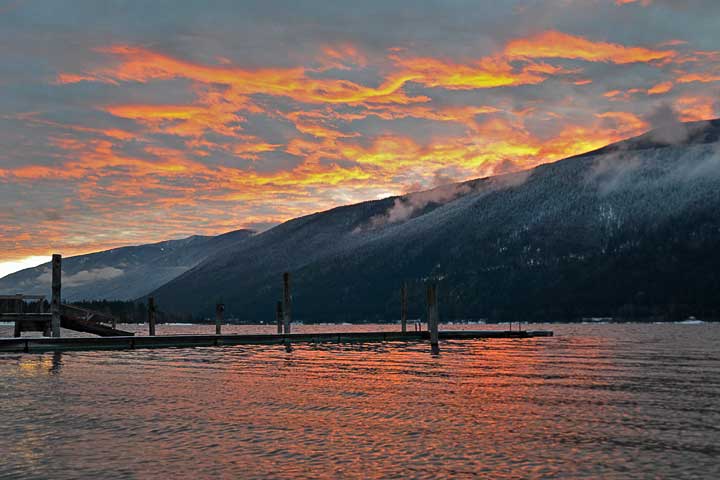
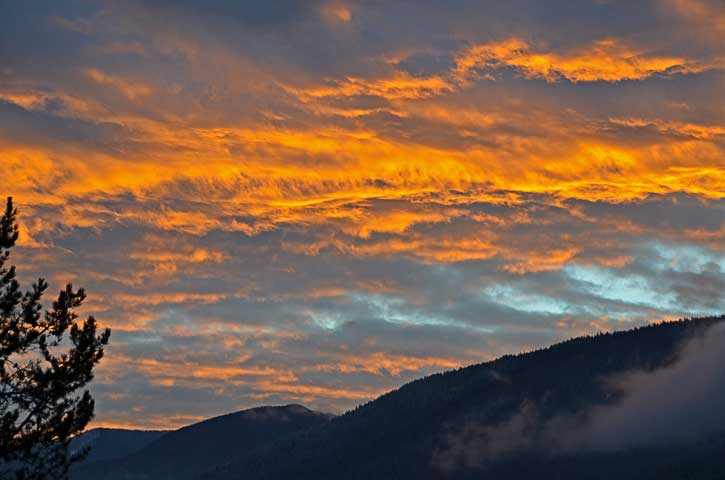
Winter brings stratus to Kootenay Lake; stratus brings skies of slate. If the cloud breaks up at dawn or dusk, the low Sun may splash the slate with fire. Such was case Christmas morn—supplemented by reflections off the lake.

Posted in weather | Comments Off on Christmas sunrise

Chestnuts Roosting…

A seasonal song (bird) at Kokanee Creek Provincial Park this morning:

Chestnuts Roosting On An Open Pond

For you non birders: These birds are Chestnut–backed Chickadees.

Posted in birds | 2 Comments

Notables & Eccentrics

Two decades ago, North–Shore resident, Ron Welwood, created a tour of the Nelson cemetery (a place officially known as the Nelson Memorial Park Cemetery). Distributed as a brochure to locals and tourists, the tour presented a delightful, sepulchral romp though some of the notables and eccentrics who once populated this valley.

Now with my help, Ron has revisited this romp with personages both longstanding—er…, long supine—and new. The website version is available on the Kootenay Lake site at Nelson’s Cemetery. A brochure version for printing has been prepared.

Enjoy.

Posted in history | 3 Comments

Whither green flash

As much as I enjoy Kootenay Lake, I must admit that living at the bottom of a deep valley has a disadvantage: I cannot see the green flash from home. I have seen the green flash many times from elsewhere, but never from around here.

As I haven’t seen the green flash locally, why write about it in this blog? Two reasons: a colleague just sent me questions about it (thus, the timing); I believe it could be seen locally (if the proper vantage could be found).

The green flash is, indeed, a flash of greenish light. It sometimes accompanies the low Sun (sunrise or sunset). It is real and it is photographable. Below is a picture I took of it many years ago, albeit one taken at the Coast. The island of green light seen atop this setting Sun is one of various forms the flash can take, yet this picture does show the form commonly seen around mountains. (Discussion continues below).

The Earth’s atmosphere acts as a prism to slightly separate colours. This colour dispersion would normally give the low Sun a thin red rim on the bottom and a thin blue rim on the top. However, air scatters most of the blue to the surrounding sky leaving the upper rim greenish. The green rim is too thin to be seen by the human eye in the absence of some refractive magnification. There are a few different atmospheric temperature structures which can produce the needed magnification. As noted, the picture shows the one most likely to be encountered around mountains.

The image of the low Sun appears as above when viewed through an undulating temperature inversion such as one sculpted by mountain waves. Serrations appear on the sides and seemingly move up (setting) or down (rising) the Sun. At the top of the Sun, serrations from each side join to form a small island of green light that lasts for perhaps a second—the green flash.

Around here, a mountaintop is the best place for an observer to gain the necessary unobstructed view of the Sun at the astronomical horizon. But, where is such a vantage to be found? Where locally can one get to the top of ridge or mountain by car (needed to pack tripod, lens, and camera) knowing that half of the journey will be in the dark: Kootenay Pass? Mount Buchanan? Where in the summer? Where in the winter?

I invite suggestions.

The Kootenay-Lake Website offers a discussion and more pictures of the local clouds in mountain waves, and local mirages from atmospheric refraction.

Posted in weather | 1 Comment

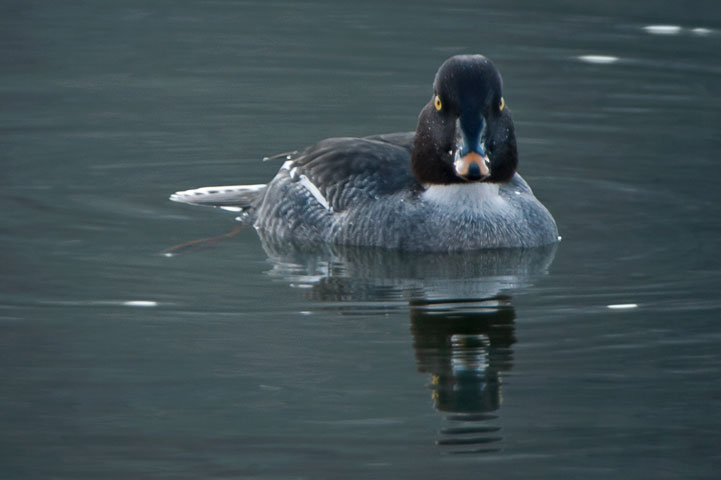
Goldeneye lassie

Those of us who live farther out along the West Arm, and so don’t have quick access to the abundance of waterfowl at Nelson’s waterfront, must make do with the crumbs which drop from Nelson’s table.

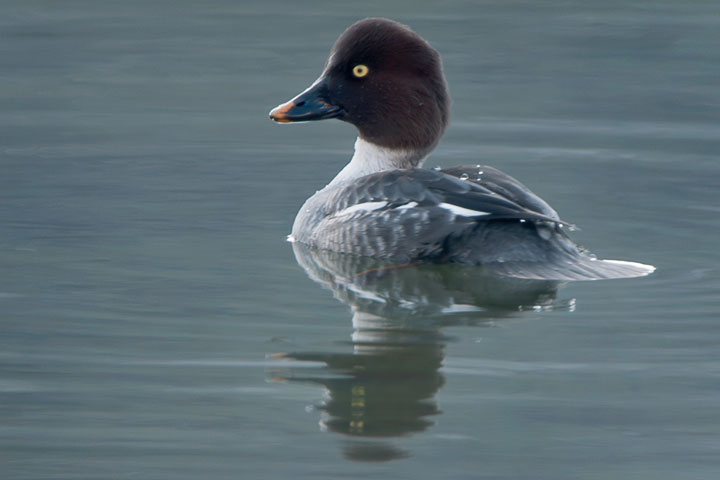
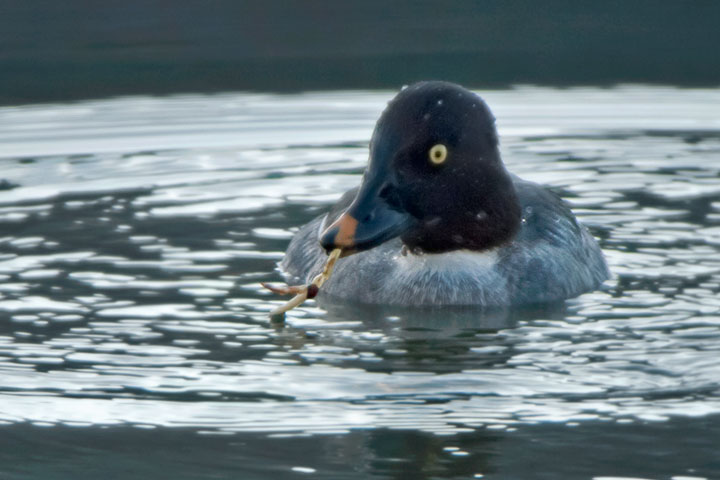
So, I have been delighted of late by regular visits of a solitary female Goldeneye. Until this morning, she did not turn up when the lighting was adequate for pictures, but at sunrise today, I managed some shots between her frequent dives. She even surfaced with a delectable in her bill on one occasion.

Two species of Goldeneye are seen around the Lake: Common and Barrow’s. The males are easy to distinguish; the females are not. Consequently, the identity of the lassie in these pictures prompted some discussion among birders, but the consensus was that she is a Common Goldeneye.  (Sibley offers some useful comments about how to tell these two species apart).

The Kootenay-Lake Website offers a discussion and more pictures of local diving ducks.

Posted in birds | Comments Off on Goldeneye lassie

Us from Above

This is an age where obtaining a view from above is as easy as using Google Earth. Beyond that, there is the even more detailed view of the residential regions around the Lake available from the RDCK site by visiting PIMS. To see the LIDAR images, zoom into a residential portion of the map until the code, lidar.SDE.LIDAR, becomes available (lower left sidebar) and then choose it. The system is slow, but worth it. (And, all this ignores the wonderful views from the weather satellites).

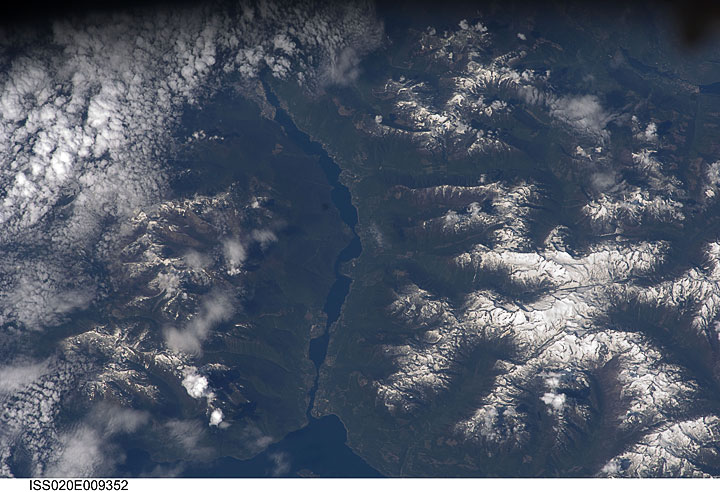
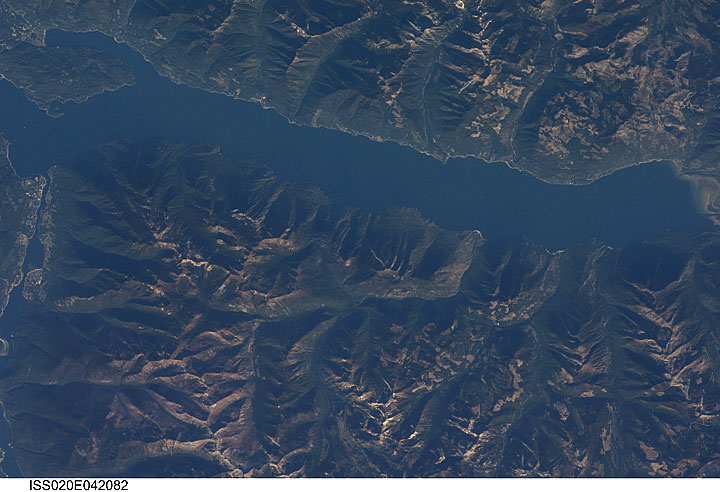
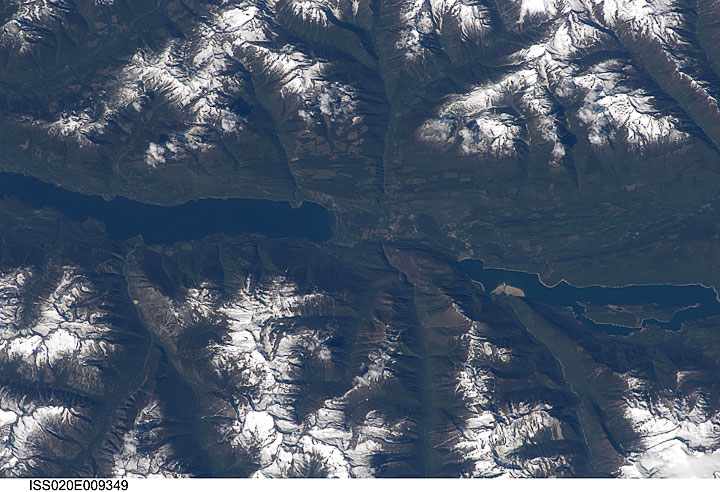
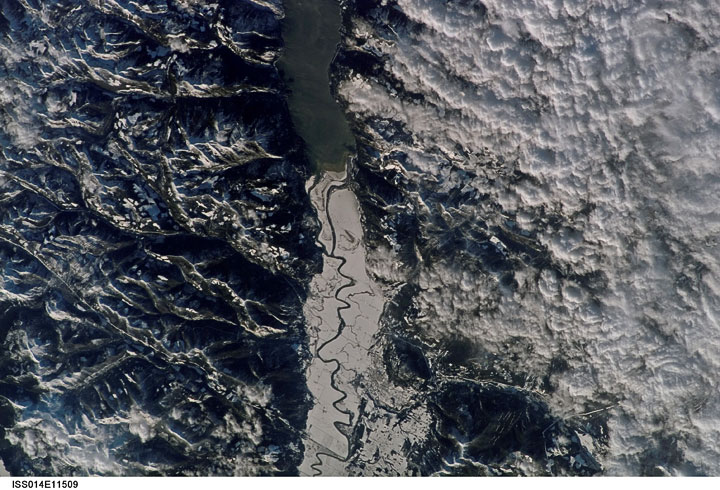
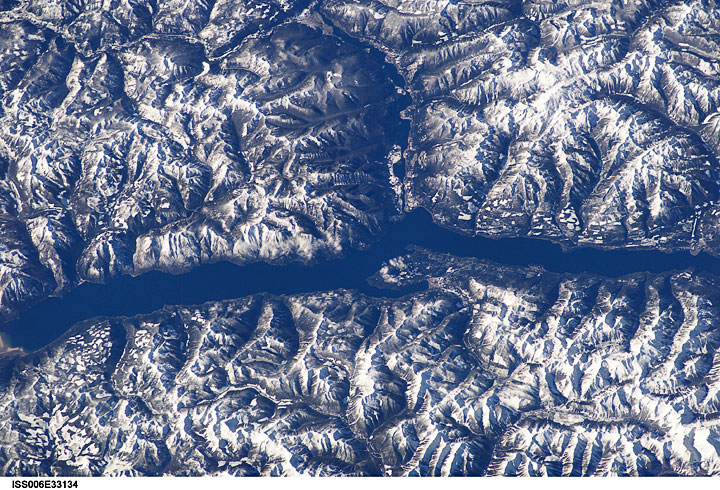
However, there remains a charm found in hand–held shots taken by astronauts with their variable dates, conditions, angles and lighting. So, this posting includes a few.

Each month, the American agency, NASA, assembles recent pictures taken by its astronauts and makes them available to the public and each month, I check to see if there are any new ones of us. This December 1st, among the nearly 6000 images released were 132 taken over BC. This looked promising so I checked for ones around Kootenay Lake. Below are five I liked. All images were taken from the International Space Station (ISS) and all are courtesy of the Image Science & Analysis Laboratory, NASA Johnson Space Center. To obtain them and others for yourself, or to get high–resolution versions, visit http://eol.jsc.nasa.gov. Enter your favourite location (e.g., Kootenay Lake) in the search box and then follow your nose. Or under the Find Photos menu, choose the Google Maps and navigate to this region.

Each of these images is much more spectacular in its high-resolution version, particularly the one which shows Creston and the south end of the Lake. The lighting and detail on it are stunning.

The West Arm from Queens Bay to Nelson taken June 13, 2009
The South Arm from Crawford Bay to Kuskanook taken September 24, 2009
North Arm from Schroeder Point to Duncan Lake taken June 13, 2009
South Arm, Creston Wildlife Management Area, and Creston on January 10, 2007
Most of the Lake, looking west on February 24, 2003
Posted in scenes | Comments Off on Us from Above

Perfect camouflage

Today, a ruffed grouse saw me watching it, but it didn’t flush. Rather, it walked away very, very slowly. It was apparently confident that in doing so it couldn’t be seen because its plumage allowed it to blend perfectly with its surroundings.

Alas, it didn’t seem to take into account all that snow.

Posted in birds | Comments Off on Perfect camouflage