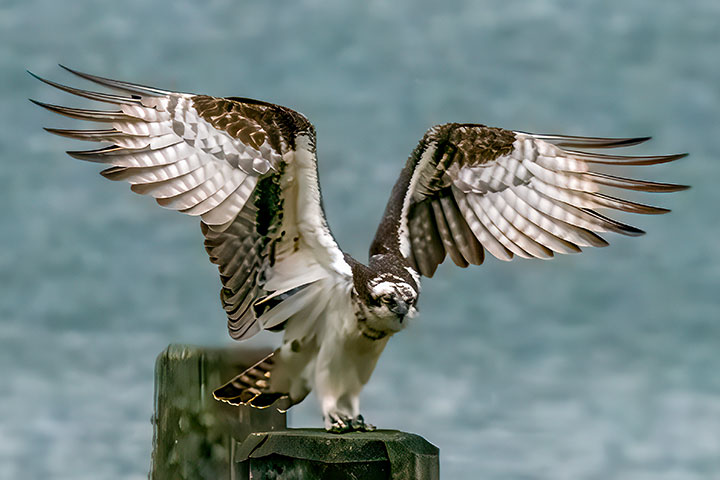
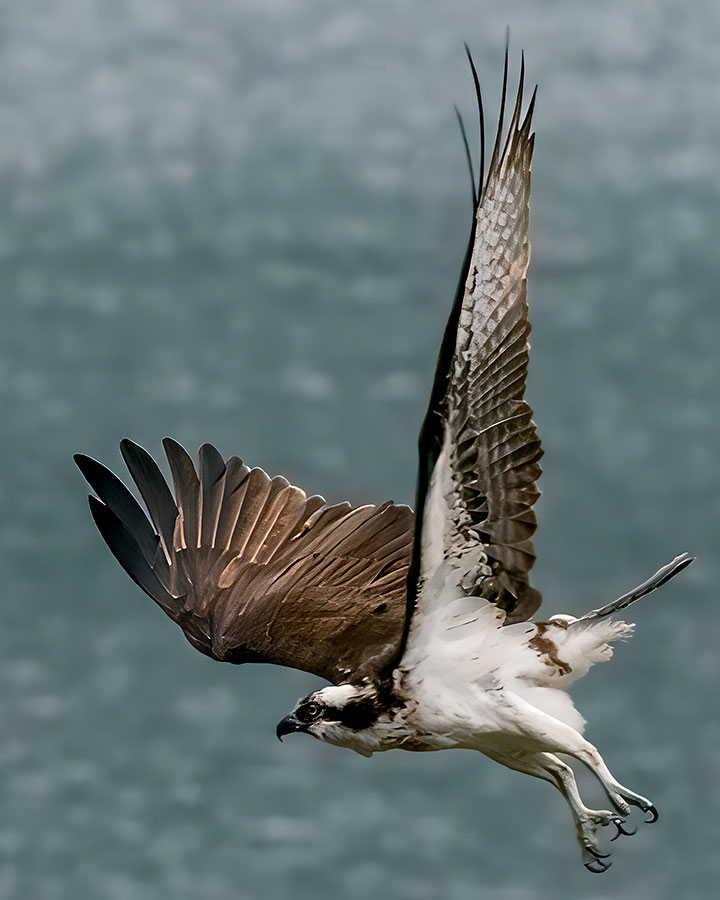
Osprey captures


Ospreys eat fish. They dive into the lake and use their feet to catch a live fish. They capture ten or more fish a day for the period of five or six months that they are here. That is a good number of fish, considering the profusion of ospreys around the lake.

 Yet, try to get a good picture of the osprey lifting a fish from the water. It is a big lake, the capture is very fleeting. And when seen, it is usually rather distant. Getting a good picture of the event is, alas, iffy.

I start with one I got seven years ago, but have waited some time to get another good one.

An osprey drags a male Kokanee from the lake on 2018 August 18.

Two days ago, Cynthia caught an osprey emerging from the Lake amidst much spray. One cannot tell yet what it might have caught.

In our most dramatic photograph of the day, Cynthia caught the osprey dragging a fish from the Lake. We thought it would have had a Kokanee. It didn’t. But what is that fish? 

A moment later I took this.


Posted in birds, fish | 6 Comments

Heron and fish


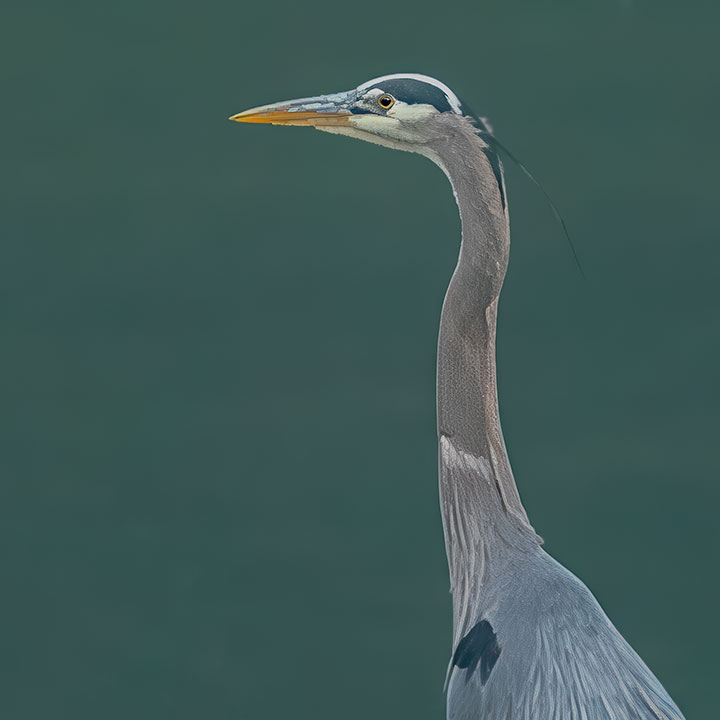
A juvenile Great Blue Heron was observed in a pond alongside Kootenay Lake. It was hunting small fish. It caught three of them before flying to the other side.

The heron would quietly stalk a fish. Upon a sighting, the strike took under a tenth of a second. The fish would then be shaken hard to stun it. Finally the heron would open its bill wide (picture shown) and then thrust its head forward to eat it.

Then, the heron decided to try its luck on the other side of the pond.


Posted in birds, fish | 3 Comments

Osprey and Kokanee


This morning, I tried to get a shot of an osprey dragging a Kokanee out of the lake. I failed.

But, this shot has to be a close second.

A female Osprey flies off with a female Kokanee salmon.


Posted in birds, fish | 7 Comments

Kingbird chicks


During their migration period, the Eastern Kingbird is reasonably common around the Lake. The chicks have now fledged, but are still being fed by their parents.

The first two pictures are old and are included to merely set the stage. The rest are from the last couple of days.

On June 21, a parent sits in the nest.

On July 15 the parents are feeding chicks in the nest with a dragonfly.

Now, the chicks are fledged and a parent searches endlessly on the wing for insects. 

A parent has caught a dragonfly.

A chick sitting away from the nest opens a wing.

A chick eats a dragonfly that a parent supplied.

Another chick has received a dragonfly from a parent. Photo by Cynthia Fraser.

And proceeds to eat it. Photo by Cynthia.

I didn’t manage a shot of a parent feeding a dragonfly to a chick, but did get one of a parent feeding a snowberry to a chick.


Posted in birds | 2 Comments

Four dragonflies


BC gets quite a few dragonflies at this time of year, but as the male and female do not look the same, there are double that number of dragonflies you can see. Here are four that I happened upon in the last few days.

This seems to be a male Autumn Meadowhawk pausing on a perch while still hunting.

A male common white tail rests on the ground.

And a female variegated meadowhawk hunts from a bush.

A male blue-eyed darner hunts on the wing for flying bugs.


Posted in bugs | 4 Comments

Heron nest, more


A day ago, I posted one picture of two heron chicks in a nest <blog.kootenay-lake.ca/?p=34785> and said that locally there were, maybe a half-dozen Great Blue Heron nests, but not one was easy to find and all were inaccessibly distant. I revisited the site, but only one nest is marginally photographable. So, here are some more pictures from that nest.

The two heron chicks look at each other.

When they would exercise their wings, they would reveal some white pin feathers on the underside. These feathers are growing and are developing, so have blood flowing through them. The pin feathers are sensitive.

The heron chicks spent much time preening.

In the heat of the day, the chicks panted.

And I just don’t know what is going  on here.


Posted in birds | 3 Comments

Heron nest


Locally, there are maybe a half-dozen Great Blue Heron nests, but none was easy to find and all were inaccessibly distant. One of the nests had two fully grown chicks which spent their time exercising their wings and preening. They will soon fly.

Two Great Blue Heron chicks stand in their nest.


Posted in birds | 3 Comments

Flying birds


The advantage of photographing a flying bird is that one can often see more of the bird because the wings may be spread.

A female Brewer’s Blackbird flies by.

A Belted Kingfisher flies by.

A Killdeer tried to lead me away from its nest, so I obliged and followed it.

Two postings ago, I showed an osprey carrying a intact fish  <blog.kootenay-lake.ca/?p=34737>. This fish, however, has already had its tasty head eaten by the osprey. This is often the way a fish gets delivered to the nest.


Posted in birds | 3 Comments

Grizzlies


Recently my parents and I visited Khutzeymateen Provincial park, located an hour and a half north of Prince Rupert by boat.

Finn’s posting: This posting was both photographed and written by Finn, who is Alistair’s grandson.

Grizzly bears are local to the Kootenays, where I previously photographed them, and indeed to most of B.C. However, they appear to be truly at home in the Khutzeymateen.

Protected as a park since 1994 (https://bcparks.ca/khutzeymateen-park-aka-khutzeymateen-ktzim-a-deen-grizzly-sanctuary/), the grizzlies of the Khutzeymateen inlet and river valley are subject to only a few commercial tours licensed to operate in the area, none of which are permitted to step on land. With rain falling 300 out of 365 days a year, the area never runs dry of food; from June until late July, bears thrive on the abundance of protein-rich (~18%) sedge grass adorning every shore. Here I share few moments spent with a mother and young cub (COY – ‘Cub of the Year’) learning to navigate its sanctuary.

B(e)arely a year old – pun intended – the cub understandably quickly grew bored of chewing on the sedge, instead opting for practicing yoga and an ambivalent flop over a nearby rock.

Meanwhile, the mother, with considerably more endurance for the task, continued munching in the vicinity.

At some point, once the cub had tired of its relaxation, it clambered down off the rock for a heartfelt reuniting with its mother.

However, the cub soon grew just as tired of its mother as consuming ‘good-for-you’ sedge, and curiously wandered down to the waterline towards us for a drink of (salty?) water. Despite the isolation, the helicopter parenting strategy is also practiced in the Khutzeymateen – the mother signalled her displeasure by rising to her hind legs, the seriousness of her gesture perhaps undermined by the half-chewed bits of sedge hanging out of her mouth.

Nevertheless we and the cub heeded her warning, and as the cub scrambled back to join its mother, we moved on and left them to roam their sanctuary.


Posted in mammals | 13 Comments

Loons & Osprey


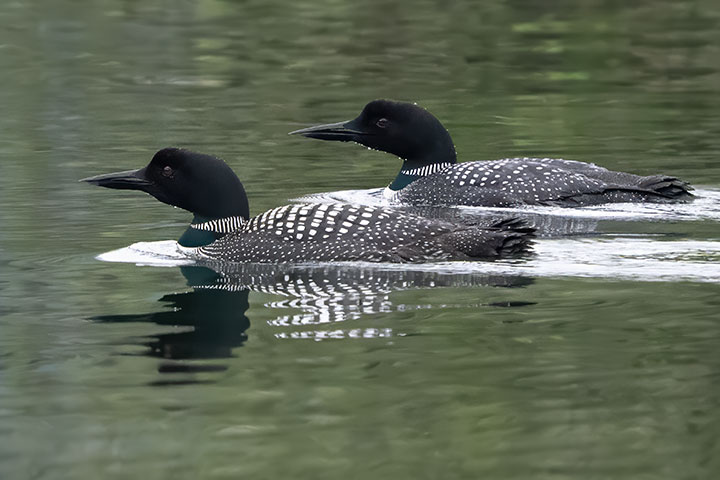
Of the many birds I saw yesterday, two stood out: loons and an osprey. This was the first time I’d seen loons in over a month since they went up to small mountain lakes to breed. And the issue with the osprey was that it had just caught a fish.

A mated couple of Common Loons (larger male on left) were down from the mountains and back on Kootenay Lake with their striking pattern of black and white plumage. Now, I have seen loons with red eyes and loons with dark eyes. So, I checked for the timing of the colour change on the web and discovered, to my surprise, that someone claimed that “common loons do always have red eyes” <https://www.birdful.org/do-common-loons-always-have-red-eyes/>. Huh? That statement contradicts observations: they don’t always have red eyes. It is the retina of the loon’s eyes that are red during breeding, but the retina are otherwise dark. As the colour of the retina does not influence seeing, the red eyes must signal that the loons are ready to breed. These loons had dark eyes so breeding is over.

The same day I watched the loons, a male osprey flew by with a fresh fish. Fresh, for the osprey, will generally mean that it has not stopped somewhere to eat the tasty head and brains before delivering the rest to its chicks. This fish still had a complete head.


Posted in birds | Comments Off on Loons & Osprey