Cormorant liftoff


The Double-crested Cormorant is a big bird — it requires a long runway to take to the air.

The cormorant is demonized in Ontario where hunters are allowed to shoot the birds on sight. However here, the cormorant is rather an interesting curiosity. Indeed, there is a bay on the outflow of Kootenay Lake where it is consistently, but rarely to be seen. And it was there that I watched two cormorants this morning. 

The cormorants didn’t seem to like being watched, even from a great distance. Upon spotting a watcher, they would systematically fly off, but that behavioural quirk gave me a chance to watch their liftoff from the water. Cormorants cannot merely jump into the air and fly off as does a mallard. Rather, they must run across the water surface so as to slowly pick up the speed necessary for flying. This is similar to the behaviour of a swan when lifting off from water. 

Two cormorants take to the air. Notice the spacing of the splashes left by their foot prints on the water. The closer one (left) has just started its liftoff and so is moving slower than the distant one (right). Its splash prints are closer together. Further, the spacing of the splash prints of the distant bird progressively get farther apart as the bird picks up speed. Ultimately, each became airborne.


Posted in birds | 1 Comment

Waggle-foot loon


People are at pains to interpret the sounds and gestures of one another. They want to do the same for animals and feel that they do a good job making sense of the signals sent by their pets.

But, what about signals from wildlife? What is the purpose of the howl of a wolf? The penguin dance of the grebe? The spread-wing stance of the dipper? The huff of the black bear? 

The communications of the loon are a particular source of fascination, in part because its calls are so evocative and beautiful. We have named four of them — wail, hoot, tremolo and yodel — and for each, a supposed message has been deduced. The loon also adopts various understood stances in its close interactions with others. So, it is not unreasonable to ask: When a loon raises its foot out of the water and waggles it, what is it signaling?

Consequently, the purpose of the waggling foot of the loon has received modest study.

It seems that the loon is communicating nothing: the bird is merely having a stretch. Chuckle.

A juvenile Common Loon waggles a foot as it drifts languidly by. Ho-hum. 


Posted in birds | 3 Comments

Otters reappear


I was delighted to see a half-dozen featureless grey ghosts visit a dilapidated dock in the faint light well before dawn. They constituted a family of otters. 

In recent times, I had been wondering about local otters for I had not seen any for 28 months. Had our local otter numbers actually diminished? Had I merely been inattentive? Could it have been both? 

Who knows? Yet, otters have now reappeared.

A family of six otters paused briefly on a dock in the dusky light well before dawn.


Posted in mammals | 2 Comments

Dowitcher


When I casually started to watch local birds a dozen years or so ago, I posited that there was no point in paying attention to shorebirds — there were just too many similar ones.

I adapt. 

With time, I realized that we have both the (rather few) standard summer residents, and the migrants (passing through, the shoulder-season visitors). So, from late July through September, I now watch for migrants.

This year, I have seen fewer migrating shore birds, and certainly the wildfire smoke of the last week or so has kept the birds and me apart. I did see a Greater Yellowlegs a month ago, but that was it — until this morning. I have just spotted a Long-billed Dowitcher foraging in a pond adjacent to the lakeshore.

A Long-billed Dowitcher looks up briefly as it forages in a pond adjacent to the lakeshore.


Posted in birds | 5 Comments

Smoke and fish


Late summer is the season of smoke and fish. The smoke is episodic — some years none, some years considerable. This year it is particularly bad. The fish, spawning kokanee, are an annual staple that is far more agreeable.

Wildfires between 500 and 1000 km to the southwest have sent a pall of smoke our way. Normally the pellucid local atmosphere permits clear views of even distant mountains. Now we cannot even see across the narrowest portions of the Lake. I illustrate the problem with two ferries on the Main Lake. On the left the MV Osprey 2000 is emerging from the mirk, while on the right the MV Balfour is vanishing into it. Sigh….

This is the spawning season for kokanee salmon around the Lake. Spawning in West Arm creeks is coming to an end, while spawning at the north end of the Main Lake is in full bloom.


Posted in fish, weather | 4 Comments

Aestivation’s over


Now that September is here, daytime temperatures are somewhat more temperate and the mourning cloak butterfly is back in abundance. 

The mourning cloak likes to avoid temperature extremes, otherwise it closes down. Over winter, it hibernates (becomes dormant to avoid the cold); over summer it aestivates (becomes dormant to avoid the heat). So, it is seen in the spring and reappears again in the fall. 

This is one of many mourning cloak butterflies to be seen at this time.


Posted in bugs | 4 Comments

Dragonfly migrant


When we think of local migrants, we usually think of birds. Indeed, many of the birds we watch most assiduously, migrate in and out our region. But…, migrating insects?

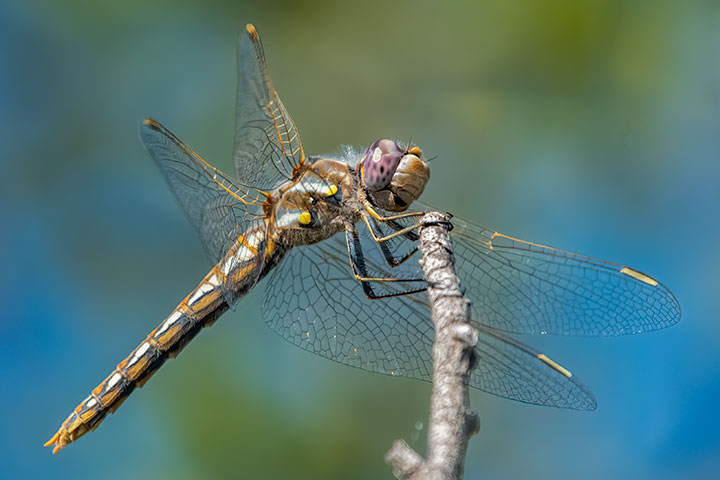
Most local insects spend their whole lives within kilometres of where they were hatched. But, a handful do not. Of our many locally-seen butterflies, there are only three migrants. But, the migrating insect seen this morning wasn’t a butterfly; it was a dragonfly, one of only two local migrants: it is the variegated meadowhawk.

Its name, variegated, — exhibiting different colours, especially as irregular patches or streaks — certainly characterizes it. Indeed, the males even shift to reddish as they age. Yet throughout these variations, all display two yellow dots on each side of the thorax.

I could learn little about its range, although it seems that this one will have originated a bit to our north and may well migrate as far south as Central America. But, unlike birds where the same individual migrates both ways, these dragonflies split their round trip across at least two generations — itself a neat trick. 

A striking looking migrating dragonfly, this variegated meadowhawk is on its southward journey.


Posted in bugs | 4 Comments

August goulash

This is collection of images taken this August that lacked a posting of their own, primarily because they were all taken within the last few days. I would have liked to include some mammals. Alas, while I saw some, there are no shots. Indeed one night (2 am), I awoke to find a rather large black bear looking in my bedroom window. If that weren’t sufficiently impolite, it then vanished as I grabbed my camera.

A juvenile Bald Eagle flies in to feed on Kokanee.

And then goes about hauling it out on the beach and eating it.  

There has been an increase in the number of kingfishers around with their chicks having fledged. 

A Great Blue Heron also flies in to feed on Kokanee.

My favourite shot of the last little while is that of a male shadow darner (dragonfly) hunting on the wing. It is difficult to photograph them as they fly by. But, this time I managed a shot so detailed that I offer it twice. This first one is an overview.

The second is a detailed view. Move the cursor across the image to see elsewhere (click on mobile device). Notice while flying, the darner tucks its legs up behind its head to reduce aerodynamic drag. And at the end of its abdomen are the appendages signalling it as a shadow darner.
[photonav url=https://blog.kootenay-lake.ca/wp-content/uploads/2020/08/shadowdarner200830Z.jpg mode=move popup=none animate=none position=right container_width=694 container_height=480]

Posted in birds, bugs | 5 Comments

Two migrants


From late July into October, we are visited by migrants. These are birds that bred to our north but stop here to feed on their southbound journey. They range in size and type from the hummingbird to the eagle. Here are two migrants that have been seen in the last two days.

Hawk
I was at my home when, amazingly, a hawk landed on a hedge in front of me. It was probably interested in the little birds at the adjacent bird feeders. But, what was the hawk? As it landed and departed, it showed a banded tail, but when perched, only its head and shoulder were visible to the camera. 

Speculation is that it was an adult (it has a dark eye) Cooper’s Hawk, but who knows?


Shorebird
Starting in late July, I casually watch for migrating shorebirds.

During our regular summer season, we only get Killdeer and Spotted Sandpipers. But, starting in late July, the floodgates open as migrators stop by to feed on their way south. Or, at least that is what is normally expected. Even observations of Spotted Sandpipers have been less common this summer, and I had to await until the dying days of August to see my first migrant. It was a Greater Yellowlegs. 

A migrating Greater Yellowlegs is feeding on a tiny fish.


Posted in birds | 2 Comments

Predaters and scavengers


Kokanee salmon flow up local creeks to spawn. Predators and scavengers gather to gorge themselves. Some come to feast on the living fish; some come to feast upon carcasses. Although these pictures were taken where the birds were feeding at the mouth of a creek, the eating was not captured. However, some rather nice flight shots of these birds were.

The osprey is a predator and specializes in catching live fish — it is the only bird in this collection that does not scavenge.

The Bald Eagle (this is a juvenile) is happy to feast on fish, either living or decayed. Here it is plummeting into the water to catch a live one. Alas, it was unsuccessful; the fish escaped.

Ravens are both predators and active participants in the scavenging community.

The Great Blue Heron is happy to feast on either living or decaying fish.

When it comes to scavenging corpses, the Turkey Vulture is pre-eminent. It is the only non-predator in this group; it avoids living fish.

My favourite shot of these events was of a Turkey Vulture flying away from me.


Posted in birds | 1 Comment