Evening Elk Herd


Photographer: In exemption of the first, by Cynthia Fraser, the photos here are taken by Finn Fraser Grathwol. More of Finn’s photos can be seen at @finnfrasergrathwolphoto on instagram.

In the late evening (read: very low shutter speeds and blurrier photos) on the way back from Arrow Lakes on Canada day, we (myself, my dad, and Cynthia) came across a herd of 15-20 Rocky Mountain Elk, the local subspecies, by the side of the highway. Judging by the antlers, the herd appears to be almost exclusively comprised of females and 1-2 year old young males, referred to as cows to bulls, respectively.

Below, courtesy of Cynthia Fraser, a larger-scale sample of this herd is pictured, including a few month old calf. 

Here, a mother and her son pose for a family portrait. 

Two males; note the difference in antler length – perhaps signifying a slight age difference.

A different male rests — or rather uses his mother for a chin rub — it is unclear what behaviour is being exhibited. 

A young male elk times his obligatory nose cleaning perfectly with my camera’s shutter. 


Posted in mammals | 1 Comment

Cavity congestion


Tree Swallows nest in holes made by others such as woodpeckers or man. Both parents help to feed their youngsters. This is the breeding season which means that there is great deal of coming and going. Often one parent must wait at the entrance with a mouth full of food, while the other completes its feeding inside.

The parent (male?) with a mouthful of insects has waited by the cavity opening. As the other parent (female?) climbs over it, the male leans back, moves the nictitating membrane over its eyes, and clamps its bill tightly closed on the insects (although some bristles stick out). Stepping on the male’s head as it leaves, the female continues on its way to fetch more food.


Posted in birds | 2 Comments

June’s goulash


This is a collection of June’s pictures that lacked a posting of their own. 

June began with a dipper feeding a bug to one of it three chicks.

This purple virgin’s-bower (Clematis occidentalis) is a western flower. If one asks an app, it is often said to be a purple clematis, which is actually only found from Ontario east. Photograph by Cynthia Fraser.

This is a catbird singing. The striking thing is that the catbird (which does have a mew call) also mimics the calls of many other species and sings their songs.

The Great Blue Heron occasionally stands with its wings spread like a balalaika as it faces the sunlight. It is baking its parasites. Further evidence of this is its extended neck and its panting as it attempts to keep the blood cool that reaches its brain.

The Black-chinned Hummingbird is well-named: it has a black chin, indeed it whole head is black. Of course with the right angle of the light…

…the black chin can turn purple. The chin is iridescent and can be used to send signals.

There are three species of garter snakes in the province: the common, the western terrestrial, and the northwestern. I believe that this is the Northwestern Garter Snake. Photograph by Cynthia Fraser.

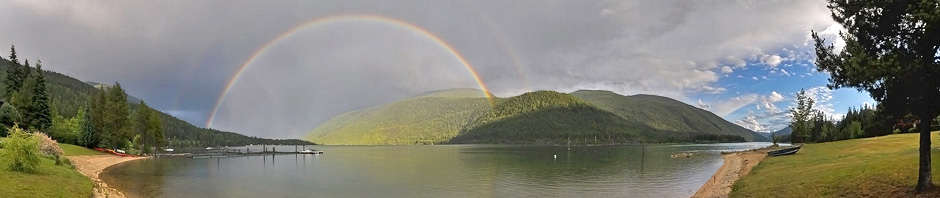
June ended with a double rainbow.


Posted in birds, herptiles, weather, wildflowers | 4 Comments

Crab spider


The hover fly is an innocent little fly, and with the advent of warm weather, there are a number of them about doing what they do: pollinate flowers. Not all creatures view them so benignly.

A few hover flies were pollinating daisies. 

But, one of those flowers contained a crab spider. Bye-bye hover fly.


Posted in bugs | 1 Comment

Merganser and fish


There are many mergansers on the Lake. Mergansers eat fish. But catch a merganser downing a fish. Lots of luck with that one. It happens very fast. The last time I succeeded with that was seven years ago.

A male Merganser tips his head back and swallows a fish whole.


Posted in birds, fish | 6 Comments

Two more wild orchids


On June 9th I posted two local wild orchids: the fairy slipper and the lady’s slipper. Each stalk had but one flower. Here are two more local wild orchids, but here the stalks contain many flowers: they are racemes.

Each of the today’s two wild flowers is a coral root characterized by the coral-like appearance of the underground rhizome. There are three species of this type of orchid around the lake. These two were found in Kokanee Creek Park (as were the slippers posted earlier).

This small plant is a spotted coral root. The growth of the flowers from the bottom to the top of the stalk is obvious in this shot. The top three flowers are about to come out.

This picture shows two stalks of the striped coral root orchid with a few of the flowers in the two racemes.


Posted in wildflowers | 2 Comments

Two wild orchids


We have a number of wild orchids, but they grow at different times. The fairy slipper has come and gone, but the lady’s slipper presented itself today. Although I said there were two wild orchids, the fairy slipper comes in two varieties, eastern and western, and we get both.

Orchids are easily distinguished from other flowers by their bilateral symmetry and (usually) one highly modified petal.

The fairy slipper, which proliferates in May comes in two varieties, eastern and western. The eastern which comes first has (among its features) yellow fake stamens.

The western fairy slipper has white fake stamens.

The lady’s slipper is with us at the moment.


Posted in wildflowers | 7 Comments

Sandpiper & fish


This is the first Spotted Sandpiper I have seen this year (on June 4th). It is also the first time I have seen one with a fish. Photograph by Cynthia Fraser.


Posted in birds, fish | 5 Comments

Bear again & again


This is the third and fourth time this male bear wearing a blaze has been seen to visit, although it has probably come by much more often.

Other years, I did not see black bears from ending hibernation until at least August, so these springtime events are worth recording. I suspect that the high snow fall in the mountains around us and the rain in the valleys have driven the bears down into the valleys. Bears? Well owing to the local unusualness of its blaze, I have just seen one bear repeatedly. 

I commented earlier that it was probably looking for garbage. It clearly found none and so seemed satisfied to eat local plants. Here it is eating clover. 

It looks as if the bear is looking at us. Maybe it is, but it was a passing glance.

This is a good time for a scratch.

For the longest time the bear seemed either unaware or unconcerned that we were watching it from a distance. However, at the end of a long session, it climbed a tree and, in the dim light, stared at us, but without the huffing sound that indicates insecurity. It then ambled to the next home. Photograph by Cynthia Fraser.

Three days later, the bear discovered a bird feeder. Photograph by Cynthia Fraser.

It set to work sampling it and destroying it. Photograph by Cynthia Fraser.

It really looks as if the bear is sticking its tongue at the photographer, but in truth it is just probably repeating the manoeuvre used on the bird feeder. Photograph by Cynthia Fraser.


Posted in mammals | 7 Comments

Eagle’s brown chick


Near the beginning of May, I posted  picture of a Bald Eagle chick in down attended by its two parents. I went back to the nest at the end of May and the chick was in dark brown plumage, but had not yet fledged.

The eagle chick in dark brown plumage sits on its nest.

An adult (probably the mother) brings a fish to eat. The head of the chick is on the left. There is evidence of a dead osprey in the nest: a body feather below the chick’s bill and some tail feathers on the right.

The chick scarfs a hunk of fish.

Later, the chick works on the whole fish. Note the fish bits on the adult’s beak.

Although it has yet to fledge, the chick exercises its wings to strengthen them. Note the fine white lines extending from the flight feathers. These are the rhaches, or the feather shafts of the flight feathers. The rhaches grow quickly and then the barbs extend from them and fill in the feather, but flight is still a while off.


Posted in birds | 1 Comment