Flood crest

The late Jack Morris of Kaslo had a rule of thumb about high water on Kootenay Lake. He would watch a patch of snow on the mountainside and he claimed that the spring flood would crest just as that snow melted.

I thought about Jack’s rule and it made good sense. At this time of year, the determining factors for the Lake’s level is inflow and the constriction at Grohman Narrows which limits the outflow. As the snow line moves up the mountain in the spring, at some point there isn’t enough snow left above it in the high mountains to melt and provide a greater flow into the Lake than out. At this point, the Lake level will start to drop.

Alas, I don’t know which spot Jack monitored, and even if I did, I wouldn’t be able to see it from my home. But, might I do even better by using the Redfish Snow Pillow—a guide to snow depth in the mountains that is available on line for all to see?

The first question is: As the snow on the pillow melts in the spring, at what (water equivalent) depth does the Lake level typically crest? After a few years of monitoring, it seems the value is about 700 mm (with some variation).

The second question is then: Can we predict when this year’s plot will descend to 700 mm? Yes, look at this year’s plot. It is the dark blue line. It looks as though it will track fairly close to the lighter blue line from a previous year. This crosses the 700 mm point on the final day of the month, or perhaps the first day of July.

Now, I am not so naïve as to believe that this approach captures all the variability possible: sudden warm spells, or extensive rain. Yet, it is probably not far off.

For now (June 8th) my expectation is that the Lake will not crest before the dying days of the month.

It is early June; the Lake is rising and hasn’t finished doing so.

Posted in weather | 2 Comments

Rhododendron Sunday

In late May or early June, many locals slip out onto the West Arm by kayak or boat and ply their way to the rhododendron grove. A Sunday’s stroll through these flower–covered trees is about as refreshing as it gets.

Yesterday, the flowers had slightly passed their peak, but remained a delight. A few images are below. Pictures from a previous year’s visit and a note about the origin of the trees can be seen on the Kootenay Lake site under Rhododendron grove.

Alas, this year when we were sated and about to leave, we discovered that the area is now posted as private. Sigh….

Posted in scenes, wildflowers | 1 Comment

Playing catchup

I wander around taking in my surroundings. Sometimes no theme presents itself for a posting. All I have is a series of unlinked scenes. Such is the case here with these half–dozen images from this last week: Painted Turtles, American Robin chick, House Finch couple, Hoverfly, Grey Catbird, Cedar Hairstreak.

The Painted Turtle is known across southern B.C where it is the Province’s only native freshwater turtle. Around Kootenay Lake, I have seen it at the south end of the Main Lake (Creston Wildlife Management Area) and at the west end of the West Arm (Grohman Narrows Provincial Park).

Birds fly into windows because they cannot distinguish the reflection presented with reality. Many birds are killed by doing so. This American Robin chick appears to have been one of the lucky ones to have survived. I heard the clunk, went outside to investigate, took a picture, and the chick promptly flew away. This is no guarantee that it was fine, but it certainly did not die on impact.

This House Finch couple is visiting a feeder. The male is on the left, the female on the right.

The hoverfly is a delightful little insect often confused with a bee—which it mimics for its own protection. It is a good pollinator, and being a fly, it does not sting. There are many different species of hoverfly, but I don’t know what is this one visiting the forget–me–nots.

The Grey Catbird is so named for the sound of its call. This one is negotiating a series of branches and has spread its tail and deployed its alulae to maintain control.

The Cedar Hairstreak is a small butterfly whose larva feed on the western red cedar tree. It flies from mid May to late June.

Posted in birds, bugs | Comments Off on Playing catchup

Do, but don’t learn

Today there was a book launching in Nelson in a children’s series entitled: Learn and Do. The book, called Let’s Plant a Flower, is aimed at small children and encourages them to go outdoors and do just that. What can I say, this is a worthy objective nicely presented.

Yet, I have a problem with it. Certainly, I am in favour of encouraging children to go outside and interact with nature. But, while the book increases a child’s sensitivity to one aspect of nature (plants), it offers the child nonsense about another (weather). To see this, you have to visit the sample pages for the book on the website for Let’s Plant a Flower, and turn a couple of pages (click on the lower right corner of a page). Presented is an impossible rainbow—one that cannot happen in the natural world.

Red is on the outside; blue is on the inside.

The drawing displays a number of unnatural features; I will mention only two.

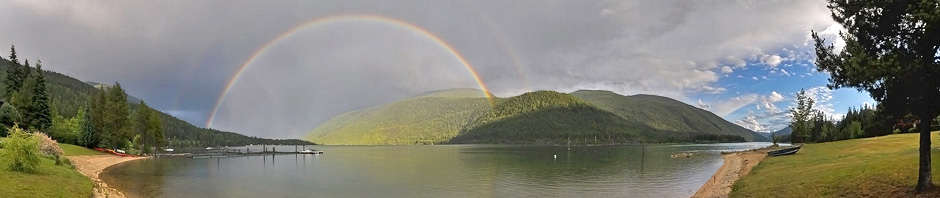
First, the colours in the book’s illustration are presented backwards. In nature, the colour order of the (primary) rainbow is red on the outside, blue on the inside. Nature is not capricious on this point. See the picture to the right, the header for this blog, or for that matter, any rainbow picture.

The observer's shadow is the centre of the bow; the Sun is on the other side of the sky.


Second, the Sun in the book’s illustration is positioned along the bow as if it were a buckle on a belt. In reality, if you look at a rainbow, the shadow of your head is the centre of the circular bow and the Sun is at your back. The Sun and the rainbow do not appear on the same side of the sky. That is just the way nature behaves.


So what? Isn’t the book’s illustration merely an example of artistic licence? Possibly, and I often thoroughly enjoy artistic licence, examples being the works of, say, Picasso or Escher. But I wouldn’t want my surgeon to have based his knowledge of anatomy on the works of Pablo Picasso, nor would I want my building contractor to have learned construction through the works of M.C. Escher. I would like such people to be grounded in reality.

In like manner, I wouldn’t want my children to learn about nature from this book.

Posted in commentary, weather | 3 Comments

Family portrait

When the kiddies are still young, the family portrait usually includes a formal shot of the whole family followed by a casual one of the children.

Posted in birds | 3 Comments

Comstock’s Sallow

Comstock’s Sallow (Feralia comstocki) is a moth. I am used to thinking about moths as being nocturnal, but this one was flying around during the day. It alighted on my driveway and started sucking nutrients (salts?) in a manner similar to that of butterflies.

From the Entomology Collection at the University of Alberta, I learn that the emergence of adults is tied to the arrival of new needle buds on conifer trees. Adults lay eggs on these buds which then serve as food for the larvae. Although common in May across southern Canada and northern US, this moth vanishes in early June.

The tongue of this Comstock’s Sallow is extended to the ground.

Identification courtesy of Butterflies and Moths of North America.

Posted in bugs | Comments Off on Comstock’s Sallow

Gorget flashing

See my gorget!

Move cursor over image; wait; move cursor off image; repeat.

Posted in birds | Comments Off on Gorget flashing

See males now

I am told that the only hummingbirds one is likely to see in the West Kootenay are the Rufous, Calliope, and Black–chinned, and they appear in that order of likelihood.

I am also told that while female hummingbirds can be seen throughout the summer, by late June the males have finished breeding and have headed higher in the mountains.

So, if one wants to see the distinctive adult male hummingbirds, the time is now—wait awhile and they are gone. A week ago, this blog showed a picture of the male Calliope Hummingbird. Today, I managed to photographed the male Rufous and the male Black-chinned.

A male Black–chinned Hummingbird

A male Rufous Hummingbird


Posted in birds | Comments Off on See males now

Two bears

I confess that in the winter I miss the bears.

So, when spring comes, I welcome them back. Thus it was fun last Saturday to watch a black bear grazing in a field. About the same time, my friend, Doug Thorburn, watched a grizzly in the woods just south of Nelson.

Now it must be noted that Nelson has had a bit of a flap over grizzlies of late. For example, see this story in the Nelson Star. Further, Doug noted that the bear he saw grazing on clover beside the Selous creek road, “had a collar on, as well as two yellow tags in its ears.” So, he was, as the police sometimes say: known.

My black bear south of Nelson, just doing his grazing thing.

Doug’s grizzly, clearly wondering if it is safe to reenter the City.

Picture used with permission.

Posted in mammals | 2 Comments

Ground squirrel

This Columbian Ground Squirrel has its burrow well out on the edge of the colony. This suggests that in the colony’s hierarchy, this squirrel ranks low. However, its suburban location did make it easier to watch.

Posted in mammals | 2 Comments