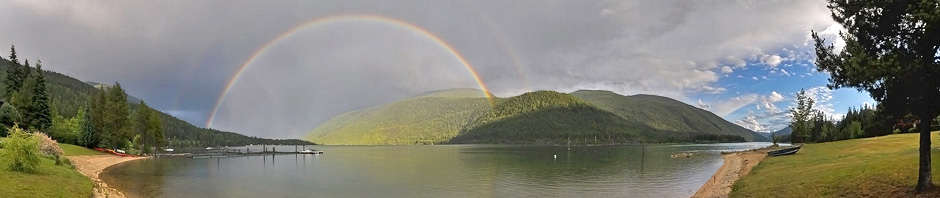
As if to proclaim the equinox, today’s sunrise was grand.
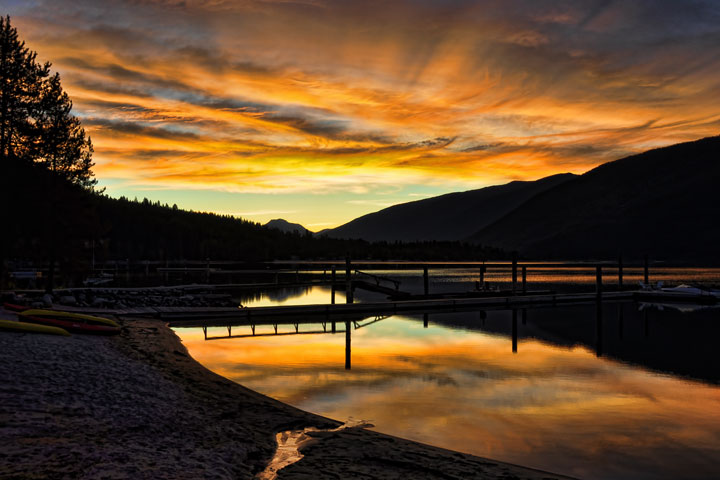
As if to proclaim the equinox, today’s sunrise was grand.
One might think that, with a title like this, I would include a picture of a gull—I don’t. Yet the gull is part of the story.
An adult (probably female) osprey packing a rather large fish stopped at a piling to feast. In mid–September, ospreys leave for Central and South America and the date was September 15th, so this may be the last osprey I see this year. Alas, it was not at the piling for long, certainly not long enough for it to enjoy its fish, a Largescale Sucker. It was soon harassed and driven off by (of all things) a Ring-billed Gull. I managed no pictures of the interaction, but the second picture shows the osprey retreating with its fish.
A short time later, a Belted Kingfisher flew by, so a picture of it is included.


The previous posting caught up on miscellaneous recent pictures of birds; this one does the same for bugs—bugs being used as a rather informal term for any arthropod.
Bluets copulate in the wheel position; the male is bluish, the female brownish. The arrangement among these damselflies is similar to that used by dragonflies, but the male holds the female by the neck rather than the back of the head and the female’s legs grasp her own abdomen, not his. Compare this image to those of copulating dragonflies presented in Sex in the park and Grohman extras.

This dragonfly is a darner—probably a Shadow Darner. Darners don’t hunt from a perch, but hunt on the wing. Focussing on a small rapidly moving object is tricky. Unlike most insects (such as bees) the four wings do not move up and down in unison. When the rear wings are up, the front wings are down, and vice versa.

This dragonfly is a Cherry–faced Meadowhawk. Compare this with the picture of the White–faced Meadowhawk shown at Grohman extras.

Finally, here is a butterfly: a Western White. The Western White does best in warm dry conditions, just what we had through August and early September.

Having a posting about a single species, such as offered with Kokanee Whimsey, is great fun, but what does one do with all the images taken that just don’t fit such a theme? Here I have grouped some recent pictures of birds that don’t fit elsewhere.
What better way to start than with a merganser enjoying a breakfast of Kokanee.

Then there is a nuthatch hanging from a branch. Everything has a yellow–green glow; that is the nature of the light filtering through the leaves.

One of the staples of the area is ravens. Here is a pair.

Always a delight to watch is a flock of Cedar Waxwings.

The ever present Bald Eagle sits above a river waiting to feast on Kokanee.

Then there were some unexpected warblers. First was a female Yellow-rumped Warbler,

followed by a Orange–crowned Warbler.


Click on this image for underwater views of Kokanee
It is September and locals arrive by the dozens—even hundreds. That is because the Kokanee arrive by the thousands—even tens of thousands. The streams and channels turn red with spawning fish. No September visit to this area is complete without a jaunt to admire our landlocked salmon.
Other years, I concentrated on taking underwater pictures of the Kokanee, such as the picture to the right, which is linked to those images and a discussion. This year I concentrated on pictures of Kokanee aerodynamics (chuckle).
If you wonder about the density of spawning Kokanee in local streams, consider this view.

To ascend a channel, a Kokanee often has to work its way past a weir. Sometimes it just pushes up through the descending water. Sometimes it jumps; that is, it launches itself into the air on a ballistic path that should take it above the weir. This picture shows four Kokanee taking to the air in an effort to climb above a weir. The red splotches in the lower left are Kokanee above the weir swimming vigorously to stay there.

In the above picture, three of the four fish are oriented nicely. The fourth has started to roll. This next picture shows a good aerodynamic orientation for a ballistic fish.

Alas it is not always so. As good as (any) fish is in controlling its orientation when in water, it is clear that a Kokanee (salmon) is rather bad at controlling it in the air. There are three rotations a balistic fish should control: pitch (nose up or down), yaw (swing to left or right), roll (turn on one’s side). The next picture shows ballistic fish, one of which has lost control of yaw. It is travelling sideways.

This picture shows a fish which has lost its control of pitch; its nose is down.

And one where the loss of pitch control resulted in nose up.

Here is a Kokanee with a rather marked problem in controlling yaw.

But, my favourite fish is this one with a severe problem with controlling roll.

Then there is a fish that despite its orientation will probably be dragged back below the weir because its tail is stuck in the water. There are other fish on the lower left that are struggling up through the water.

I take my camera for a walk along the lakeshore just as others might take their dogs for a walk. My guess is that camera walkers and dog walkers will often see different things. On yesterday’s walk, I saw three species of four–footed butterflies. Do dogs spook butterflies?
Also known as brush–footed butterflies, members of this group stand on only four feet; over time their former front two legs have been reduced to small brushes. The group is large and has many colourful members. Seen on this walk were a Green Comma, a Mourning Cloak, and a Lorquin’s Admiral.
This Green Comma alighted on a beach and began to sip nutrients. In this view, the foot number is not evident.
This is the same butterfly as shown above. That it has only two legs on the nearside is evident. Commas gain their name from a small white comma–shaped mark on the underside of the rear underwing.

The Mourning Cloak is unusual in that it can live a whole year and hibernate through the winter. It gains its name from the match between its colours and those of a cloak traditionally worn in parts of northern Europe during periods of mourning.

The underwings of the Mourning Cloak are not nearly as colourful, but in this view with its wings raised, the four legs can be seen, as can its extended tongue.

As with the two butterflies, above, the Lorquin’s Admiral is frequently seen sipping nutrients from moist ground. However, it also often perches in trees, apparently to bask in sunlight. This side view clearly shows its four legs.
High in the mountains above Nelson, the indefatigable Doug Thorburn has discovered blazes that mark a forgotten trail. The purpose of the trail is unclear, but it passes through a fine old–growth stand of cedar hemlock.
Some blazes are still visible, although the growing trees are slowly engulfing the writing. One seems to read: “Johnson, FATE, 1938”. Does anyone have any insights into this mystery?
Below are four of Doug’s pictures.


 Doug Thorburn’s pictures are used with permission.
In an earlier posting, Sex in the park, I said there would be a followup offering of other pictures from Grohman Narrows Provincial Park. This is it.
Painted Turtles are a staple of the pond in the summer. Some of these have peeling scutes. The dragonfly (a darner) that is approaching managed to pass the turtles without being eaten.

There was also a Green Comma,

and a Grey Catbird,

but the stars of late summer are the dragonflies. Here is a Canada Darner (?),

a Hudsonian Whiteface,

and copulating White-faced Meadowhawks (shown earlier were copulating Striped Meadowhawks).

I have never managed to photograph a Hoary Marmot—the Yellow–bellied Marmot, yes, but the Hoary Marmot, no. So, when Bethany Arndt showed me the pictures she had taken on a hike into Kokanee Glacier Park, I asked to post them and she agreed.
In regions, such as this, where both species of marmot flourish, they are separated by altitude—Yellow-bellied in valleys, and Hoary in mountains. The Hoary Marmot inhabits scree slopes adjacent to the abundant meadows of vegetation upon which it feeds.
Away from humans, the Hoary Marmot is wary, but along hiker’s trails, it will approach and seek a portion of the hiker’s trail mix.
A Hoary Marmot sits in a field of Western Anemone.

A mendicant marmot makes for close pictures.
 Bethany Arndt’s pictures are used with permission.
Warning. As they say in the movies: mature theme, graphic scenes.
Dragonflies abound in the marsh at Grohman Narrows Provincial Park: many species, many individuals. All seem to have one thing on their minds: procreation. Out of all that activity, one species is featured here: the Striped Meadowhawk. (Others will appear in a subsequent posting).
Dragonflies (and damselflies) mate in the wheel position. The male grasps the back of the female’s head using claspers at the tip of his abdomen. She swings the tip of her abdomen up below him to receive sperm. After mating, they revert to the tandem position whereby he continues to hold her head and accompany her as she flies around dropping eggs.
A male Striped Meadowhawk poses for a portrait on a dried leaf. It is named for the white stripes on its thorax.

Those white stripes are more evident in this profile view. It is easier to find and photograph solitary males than solitary females. The males hang around the water’s edge waiting for females. As soon as a female appears, a male approaches her and copulation begins.

Striped Meadowhawks are copulating on the grass. They are in the wheel position. The male (red) is holding onto the grass with his legs and holding onto the female (brownish) by the back of her head with his claspers. She is holding his abdomen with her legs, and has swung her abdomen up under him to receive his sperm.

From behind, one can see the male’s claspers holding the female’s head.

These Striped Meadowhawks are copulating in midair. This was a rather difficult picture to take as they didn’t hang in one spot, but drifted around rapidly during their rather vigorous activity.

The same couple is now flying in the tandem position while she drops the fertilized eggs on the ground. The eggs are visible at the tip of her abdomen.
