Cloud estimate error

We don’t have just one way of estimating the distance to an object; we have many. When objects are nearby, we use our stereo vision to judge spacial distribution. Beyond ten meters or so, we need other clues. If we know the characteristic size of something, such as a person, house, or tree, we judge distance by seeing how large it appears in the eye (its angular size): the smaller, the farther away. And if one object blocks another, that object is assumed to be closer to us.

Contrast decreases with distance through air

When we try to estimate the distance to objects of markedly variable size, such as mountains or clouds that might, or might not block one another, we use contrast. When seen through our atmosphere, the farther away an object is the lower its contrast: with distance, dark objects become lighter; with distant, light objects become darker. In the end with great distance, everything approaches the uniform brightness of the horizon sky.

Contrast works fairly well to estimate distances when one is looking at a solid object that doesn’t, itself, transmit light. But, how does one employ contrast to judge the distance to an inherently diaphanous object? What happens if one is looking at a veil of cirrus? The answer is: we usually get it wrong.

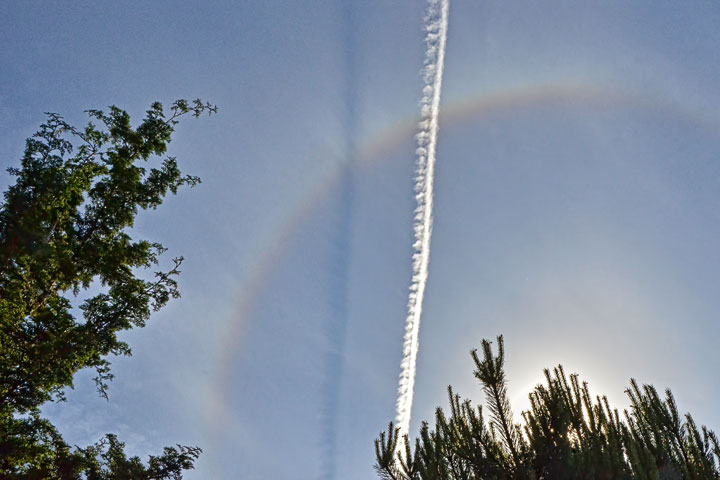
This morning, there was a veil of cirrus. Indeed, along with presenting a slightly streaky, milky sky, it produced a 22° halo. Then an airplane came by and left a well defined contrail. To our practiced eyes, the high contrast of the contrail makes it seem closer to us than the low contrast of the cirrus. Indeed, the contrail appears to block the view of the cirrus. Clearly, the contrail is closer and thus lower in the sky.

Yet, we would be wrong. The clue to the error is the shadow of the contrail on the cirrus. The cirrus has to be lower in the sky or the Sun would not be able to cast the shadow of the contrail onto the cirrus. The geometry of shadows tells all.

Alas, although an object’s contrast is usually a reliable measure of relative distance, our perceptions would miss this one. This diaphanous veil of cirrus is lower in the sky, and so closer to us, than is the contrail.
Posted in weather | 2 Comments

Loons, merganser

A Common Loon couple and a Common Merganser male came by yesterday.

With each visit of loons I try to get better shots. On this occasion, the loons were a bit closer to the shore than they usually are and this allowed marginal improvements.  Mergansers come by far too often for me to photograph each one, but a flapping and moulting male made for an interesting animation, below.

The loon couple cruises. The body of the far one (probably the female) is submerged.

The loon couple stick their heads in the water and scan for fish.

With its neck extended to an unusual length, this loon looks like a goose wannabe.

This male merganser looks somewhat dishevelled for it has started to moult out of its breading  plumage. This picture is an animation. To see the merganser flap its wings, roll the cursor over the image, wait, roll it off, repeat.

Posted in birds | Comments Off on Loons, merganser

That’s my flower

When it cleared for a time this afternoon following days of vigourous rains and winds (see Clapotis gaufré), I wandered around the yard to see if there were any pollinators in evidence. Alas no, they all seemed to be in hiding.

For a peek at last year’s pollinator hunters, look at my posting Watching crab spiders.

But, I wasn’t the only one out there looking around for pollinators. On one daisy, I saw my year’s first crab spider. Mind you, in the absence of pollinators, it really did look as if it were prepared to challenge me for the rights to its flower. I backed away and left it to its domain.

Posted in bugs | 1 Comment

Clapotis gaufré

The elements raged: Thursday afternoon brought lightning, thunder, graupel, strong west winds, waves, and best of all, clapotis gaufré.

Clapotis is derived from the French, le clapotis, meaning standing waves. Gaufré means waffled. So, together it describes a waffled pattern of waves that don’t travel but stay in one spot. But, describing it, does not explain it.

A search for clapotis on the web produced a recent (2004) additional meaning: a knitted shawl displaying a wavy pattern.

Clapotis (by itself) arises when a uniform train of water waves approaches and is reflected by a hard vertical barrier (as distinct from an irregular one such as rocks or a sloping one such as a beach). As each crest of the reflected waves passes back through a crest of an incoming wave, a very large stationary crest is produced: it does not travel; it stands on a spot and the wave goes up and down. This is assuming the waves approach the reflecting barrier at right angles.

When waves approach and are reflected diagonally, the pattern becomes cross hatched to give clapotis gaufré. That is happening in the picture, below. A train of waves from the west pounds the ramp giving a waffle–like pattern of water towers.

Before becoming very high, the crests of a travelling water wave will break and give white caps (as can be seen beyond the dock). Normally, the crests of clapotis do not break, but merely produce a tower of water. In the picture, below, the crests of the highest waves are being torn apart by the wind.

A uniform train of waves approaches from the right, hits the ramp diagonally and gives a waffle pattern of water towers: clapotis gaufré. In addition there are diagonal streaks of rain cutting across the picture.

Posted in weather | Comments Off on Clapotis gaufré

Water babies

Water babies exist.

Of course, they don’t exist in the manner conceived of by the Reverend Charles Kingsley in his 1863 children’s story. He used a corrupted version of nature as a morality play about redemption. But, we don’t need to reduce nature to a metaphor, we can look out onto the Lake in the spring and delight in real water babies. A few are below.

Sometimes momma merganser has come by with over a dozen chicks. Yet, I am happy to see one.

This family of mallards has eight chicks.

Posted in birds | Comments Off on Water babies

Halo substitution

Today the cirrus contained columnar ice crystals, rather than plates. This meant no circumhorizontal arc, but other haloes compensated.

At noon, for a few weeks around the summer solstice I watch for the circumhorizontal arc. This is a really very colourful arc lying parallel to and just above the horizon. Actually, it is not all that rare when the Sun is high enough in the sky for it to form. The ideal solar elevation is 68°. At Nelson, the Sun reaches a maximum elevation of 64° at solar noon (about 12:50DST) on the summer solstice (June 21). That’s close, so for maybe an hour a day, for a week a year, the arc might be able to be seen from around here.

Today was sunny and there was cirrus—almost optimal. The only other needed ingredient in the recipe was that the cirrus had to contain the requisite prisms: plate–like ice crystals. Now, most ice crystals in the atmosphere come in two basic forms (with lots of variations), hexagonal columns and hexagonal plates. Think of the columns as wooden pencils scattered randomly on a table; think of the plates as hexagonal dinner plates, again scattered over the table. The formation of the circumhorizontal arc requires the plates; today the cirrus delivered columns.

However, the columnar ice crystals did give a nice display—albeit not the one I sought. The picture below shows three haloes: The inner circle around the Sun (which looks too large owing to overexposure) is the 22° halo. Surrounding it is an elliptical shape called the circumscribed halo; it is coincident with the 22° halo at the top (upper part of the picture) and bottom (out of the picture), but shows a small separation on the left and right. At this solar elevation these haloes are caused by the columns. The centre of each of these haloes is the Sun.

The Kootenay Lake website offers other pictures and more discussion of these haloes. To get a sense of just how lovely the circumhorizontal arc can be, see the posting about its low–sun brother, the circumzenithal arc.

A third halo appears, but is a bit subtle: the parhelic circle. This is a white arc that circles the sky at the elevation of the Sun. In this picture it is seen passing through the sun, and cutting across the other haloes at about 2 and 10 o’clock. The centre of this halo is the zenith, which is locate just above the 22° halo.

What can I say: it was a nice display, even if it wasn’t what I hoped to see.

Posted in weather | Comments Off on Halo substitution

Butterflies for lunch

There are worse ways to spend one’s lunch hour than to wander around looking at butterflies. I saw a number of species midday, but only two were wont to pose long enough for me to take satisfactory portraits.

My favourite is this first picture of a Pale Swallowtail on the fresh growth of a Douglasfir. Notice that it isn’t feeding. Not only does the Douglasfir offer no nectar, but the butterfly’s probosces is coiled below its head.

Similarly, this Western Tiger Swallowtail on a Western Red Cedar must merely be resting. It is siesta time.

Look at the coiled probosces of this Pale Swallowtail. It is clearly not feeding.

Entomologists have long suspected that the function of the tails on the swallowtail butterflies is to mislead hungry birds. A bird would grab at the tail and it would merely break off. This swallow–half–tail butterfly is evidence of the success of the butterfly’s ruse.


Posted in bugs | 4 Comments

Mentor passing

I hope that the handful of people who follow this blog will forgive me for wandering somewhat off topic. This website and its blog explore the natural world around Kootenay Lake. Other than to describe what I see, I don’t talk about myself.

Yet, this posting is personal and it is deeply felt. It is about my mentor, Professor R.S. Scorer. He died this May at the age of 91. But, being about him, it is also about me and how he informed my view of nature. And that makes him relevant to this website.

At his funeral, I offered these few words:

Dick Scorer was the consummate naturalist: he would observe his surroundings through far more perceptive eyes than most others, and had the impressive capability to use physics to make sense of what he saw. He didn’t just see events; he saw processes.

I was a beginning meteorologist in 1963 when I read Ludlam’s and his book, Cloud Study. I had never imagined that one could view nature this way. For me at the time, physics was something that took place in a laboratory and meteorology was the creature of a vast set of data processed by colonies of ants. But, Dick would look at a cloud, at frost, at a halo, and use his knowledge of physics and mathematics to read his surroundings as others would read a book. I had to study with this man.

I did study with him. Certainly, I learned a great deal about solving problems and presenting ideas, but the primary thing that he gave me was an inquisitive view, but one constrained and informed by the laws of physics. His approach guided me through years of research, writing, and teaching. Now that I have retired, it guides my observation and interpretation of the birds, bears, and bugs around me—and, of course, clouds.

I owe an unpayable debt to Dick Scorer—he taught me how to make sense of my surroundings.

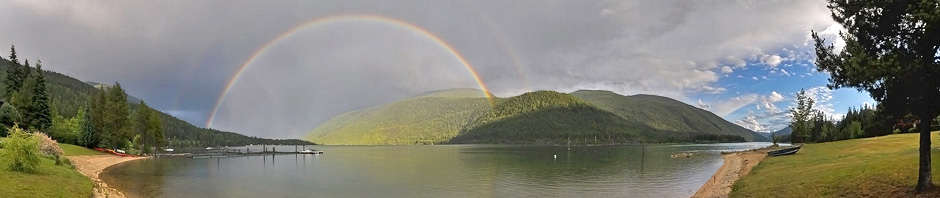
As I was preparing this posting, I looked out the window. There was a rainbow. Poignant, for the only two physical gifts Dick and I ever exchanged were books about the rainbow. He gave me a copy of Carl Boyer’s classic book (1959), The Rainbow From Myth to Mathematics. Years later, I returned the compliment by giving him an autographed copy of my own book on the subject: Raymond L. Lee, Jr. and Alistair B. Fraser (2001), THE RAINBOW BRIDGE: Rainbows in Art, Myth, and Science. (It is not by accident that the header image on this blog features a rainbow).

In memory of Dick Scorer: a picture of this evening’s rainbow and its reflection in the waters of Kootenay Lake.


Posted in commentary, history, weather | 2 Comments

Otter obs

River Otters are here, but I only get to see one on the Lake every year or possibly every year and a half.

In fairness to the otter I wait until it comes to me. If it were a beaver or muskrat, I would know where to look to find one, but with the otter—well, I haven’t a clue, so I only see it when it visits me.

The Kootenay Lake website offers other, and better pictures, of local River Otters.

As usual when it comes, it only stops by for a few minutes. It hops out of the Lake, frolics on a dock and is soon gone again out onto the Lake. Maybe someday I will figure out where it lives, but for now, I must be content with an occasional visit.

An otter stops by a dock as a log floats by.

And of course I have to include a picture which shows the result of the rising water.

Posted in mammals | Comments Off on Otter obs

Bears, bugs, birds

I sometimes whimsically characterize kootenay-lake.ca as a website that treats bears, bugs, birds, and beaches. So, why not use that list as the theme for a posting? Alas, the only beach I show here is underwater, but it will have to do. These eight pictures were all taken within the last ten days.

This mother bear had cubs nearby, but they stayed hidden while I watched.

The Pale Swallowtail is a western butterfly common to southern BC.

Although there are many insects in my yard, I rarely see a Soldier Fly (Oxycera sp.).

This Bald–faced Hornet posed for a portrait. And yes, this is definitely the lassie you do not want to annoy.

This Spotted Sandpiper was patrolling what a few weeks ago would have been beach.

A Willow Flycatcher waits on a perch to fly out to catch insects in flight.

This female Rufous Hummingbird looks like a sword on wings.

The male Black–chinned Hummingbird is still around, but likely to leave for the mountains soon.

Posted in birds, bugs, mammals | 4 Comments