This is the season when we are visited by the largest waterfowl in the world: the Trumpeter Swan. In the last few days there have been about 30 of them in the waters south and west of Kokanee Creek Park.
Yet, if we were to go back a century, they would not have been seen here, for very few then existed. The problem was that people had been systematically killing and eating them. They also sold their skin and feathers. The number of Trumpeters plummeted. This barbarism was subsequently stopped and the Trumpeter has since flourished.
Mind you, the Trumpeter Swan does not live here permanently, but does visit for weeks on end to feed as it migrates North to breed.
Normally, when one sees Trumpeter Swans, they are sleeping, feeding, or preening including the feather-straightening exercise of wing spreading.
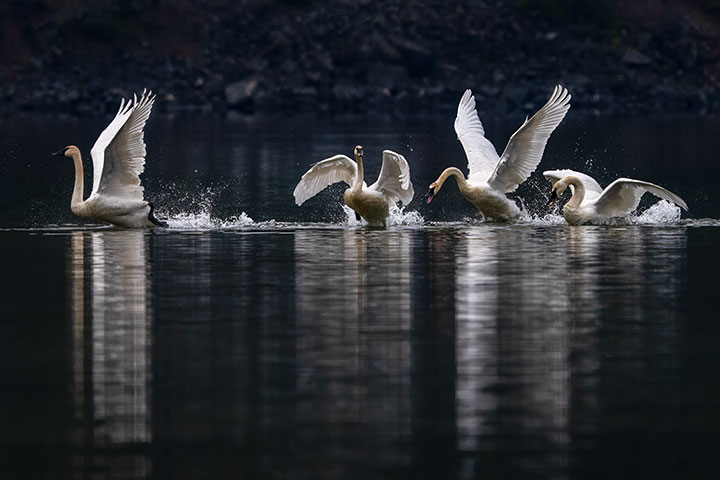
Yet, in the last couple of days, the behaviour also included courting, fighting, taking off, flying, and landing.
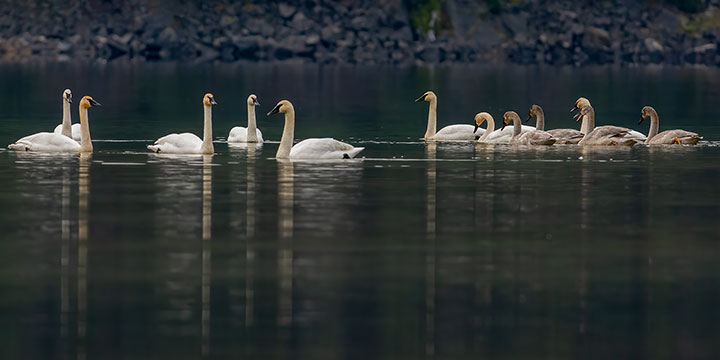
Some of the thirty Trumpeter Swans south of Kokanee Creek Park. Photo by Cynthia.
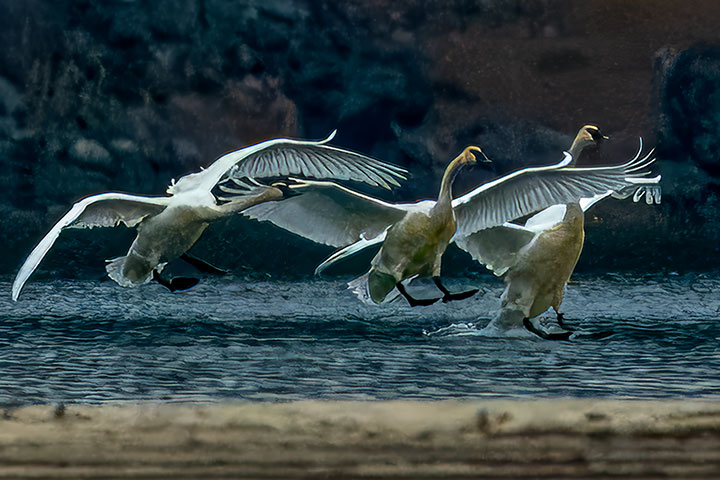
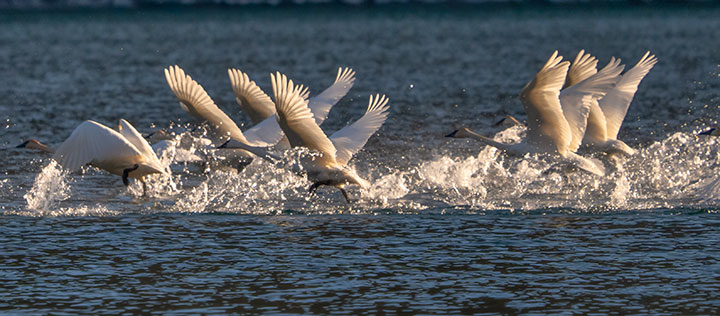
A lead group of Trumpeter Swans runs across the waters as it picks up enough speed to become airborne. Being very heavy birds, it will take about 100 metres of running before they become airborne. The taking to the air had been prompted by the arrival of a planing boat approaching from the west.
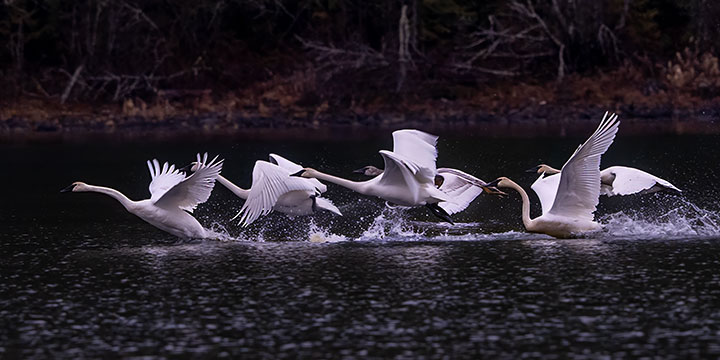
The group was eventually airborne. Photo by Dorothy.
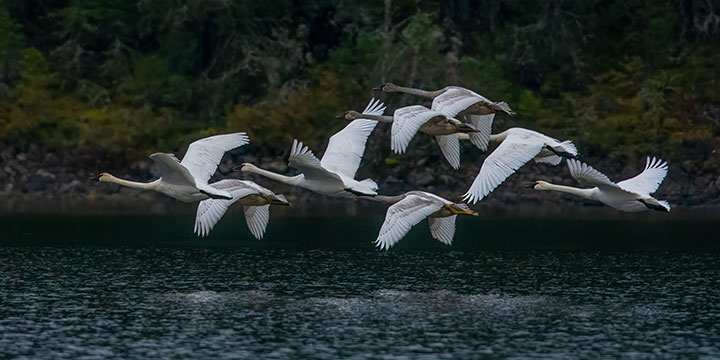
They got higher and with the passage of the boat, they turned around and headed west.
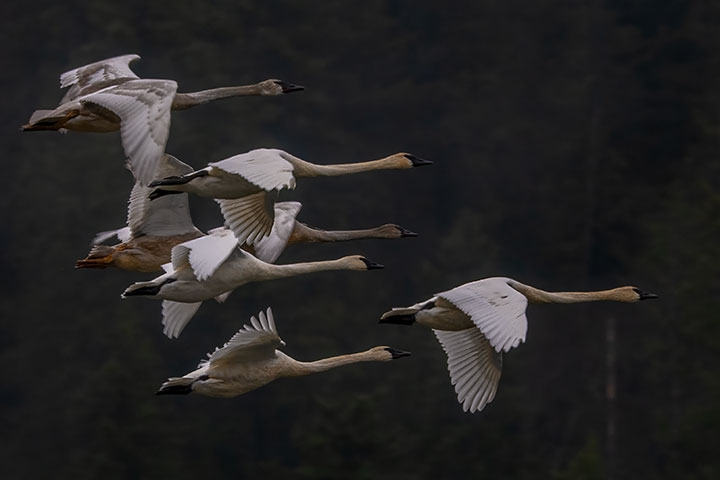
Most swans landed around a corner to the west. Photo by Cynthia.
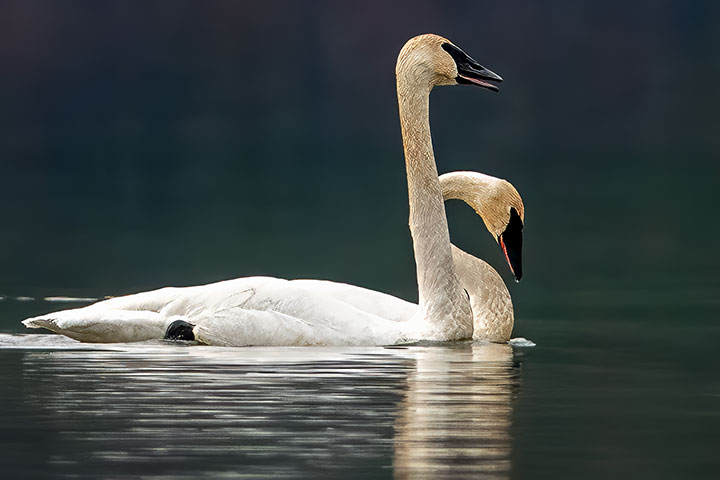
Some of the swans were seen courting by repeatedly bobbing their heads up and down. Photo by Cynthia.
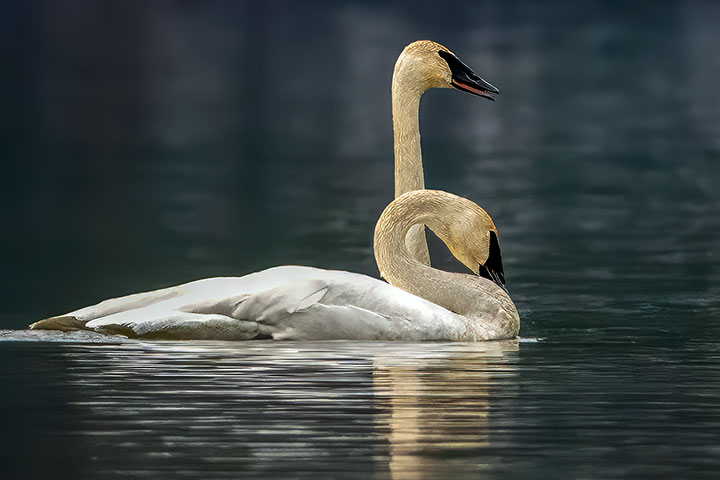
Now, the other swan bobs its head down. Photo by Cynthia.
Moments later this pair of courting swans drifted close to another courting pair and this caused a ruckus with one male challenging the other. There are two couples here: female and male on the left and male and female on the right. When they moved farther appart, they all settled back down, but the courting was over for the time being.
January is the earliest we’ve observed trumpeters doing what appears to be courting behaviours at Kokanee Creek Park. Cynthia first documented some exquisite trumpeter courting behaviours on Kootenay Lake in March 2024: https://blog.kootenay-lake.ca/?p” onclick=”return false” onmousedown=”return false=33075.
Non-pigment blue
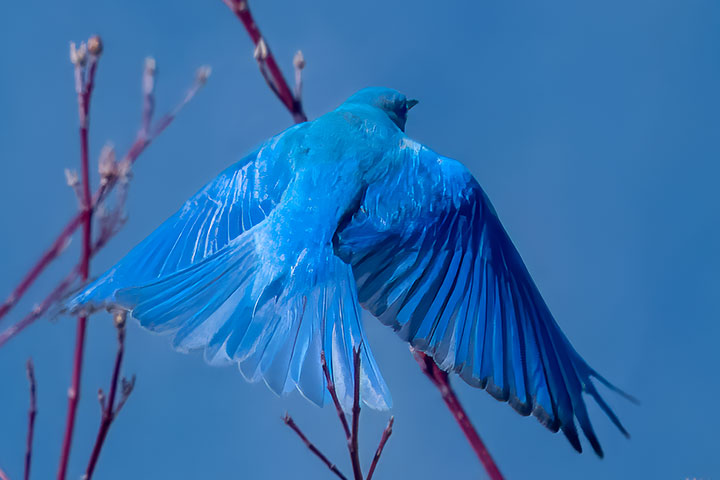
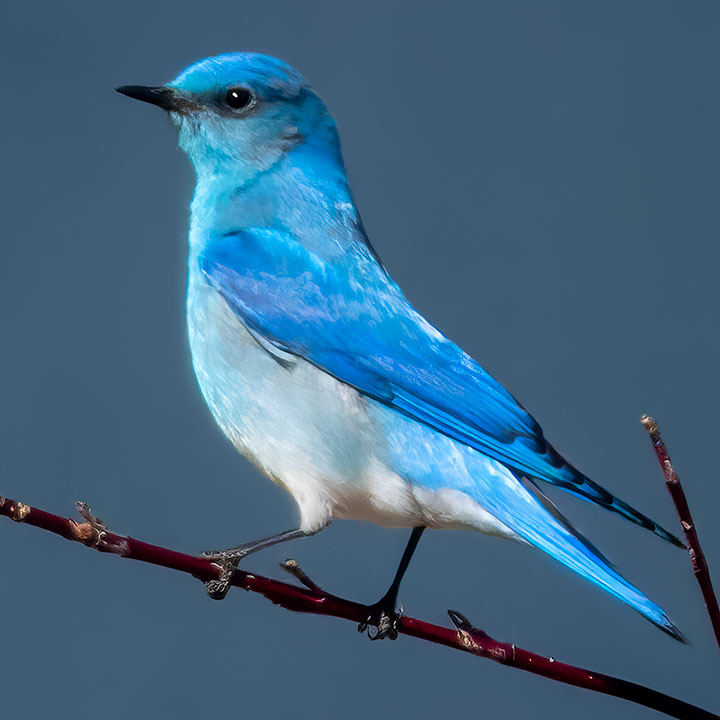
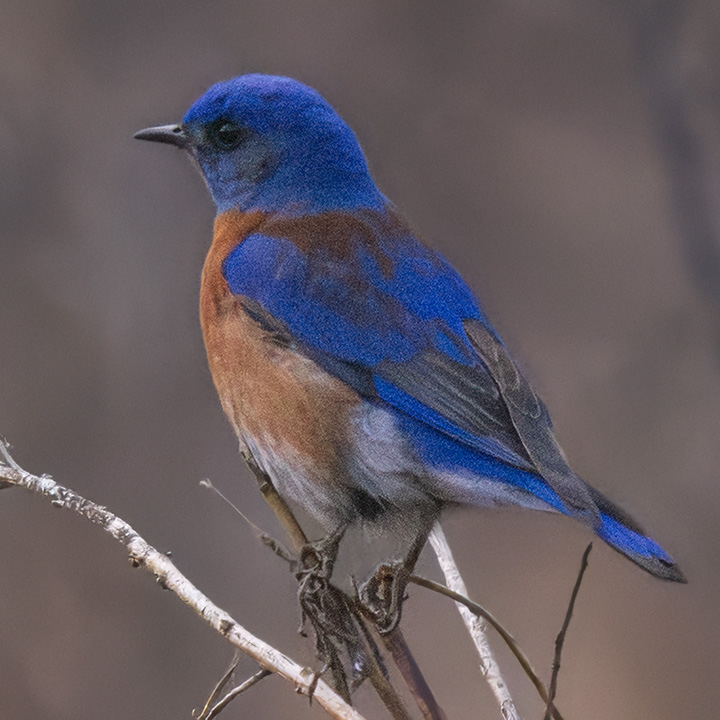
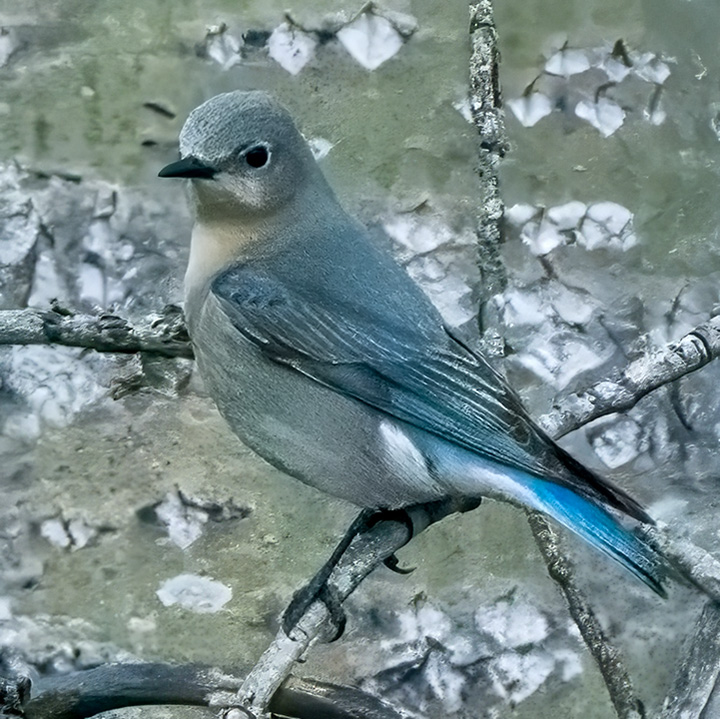
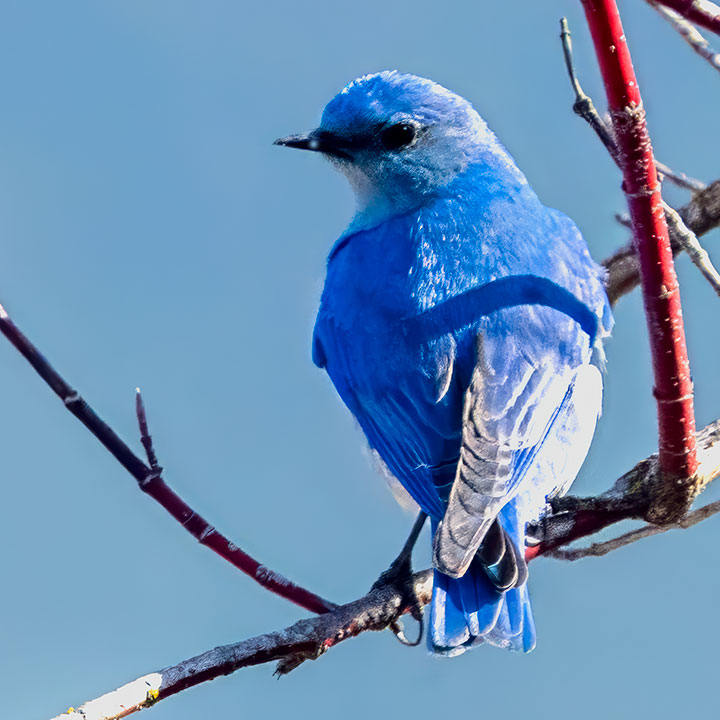
I like the Mountain Bluebird. Four days ago, I watched it fly against the blue sky. What is striking about this is that neither the bluebird, nor the sky gains its colour from a pigment.
Now, the majority of naturally coloured things around us show their colour as a result of pigments. A pigment is a chemical that absorbs only certain colours and reflects the others. So, a green object is green because chemicals absorb the other colours, but reflect green light. This behaviour is not true of the blue sky, and it is not true of the bluebird. Neither of them have a pigment that absorbs all the wavelengths other than blue. They produce blue by their geometric structure.
Indeed, a blue chemical pigment is a rather rare thing in nature. Look around in the natural world. There are very few things that are blue: the clear sky, lake water, some berries, and a few birds. An explanation for the lack of blue pigments is unclear, but the consequences of the substitutional geometric structures are stunning.
Indeed, birders know that pigmented colours are not the only way colours can be produced. Consider the gorget of a hummingbird. It may appear black as seen one way, and incandescent orange if the bird’s head is turned.
In the early nineteenth century, one of the great unknowns was why the clear sky was blue. This was solved in the latter part of the century as being an interaction of light and the air molecules. Blue light has the shortest wavelength of visible light and thus is most easily scattered by an interaction with tiny molecules. The other colours had longer wavelengths and to a larger extent they just washed by molecules without having much interaction. The air molecules had no pigments; but the small blue wavelength was scattered whenever it interacted with the smaller molecules in the air. It was a blue colour resulting from a geometric structure.
But what about the bluebird? Now many birds come in a stunning array of colours. Most of them have pigment chemicals that colour parts of them, say, with red, yellow, or green. But, not bluebirds. They get the blue colour from the geometric structure of the feathers. This structural dependance becomes evident when feathers are ground up. Grind up a green, yellow or red feather and the resulting powder has the same colour. Grind a brilliant blue feather and the result is not blue but just a dark powder. Grinding has destroyed the geometric structure that produced the blue light.
The blue of a bluebird results from tiny air cavities in its feathers. These cavities act like tiny particles by selectively scattering blue light, and as such, they behave analogously to air molecules creating the clear blue sky.
A Mountain Bluebird flies against a blue sky. Both bird and sky are blue as a result of light scattered by very small geometric structures, rather than by a chemical pigment. Of course the branches of the red osier dogwood, also seen here, gains its colour from a pigment.