Perhaps my favourite set of tracks to find in snow are those of the snowshoe hare. This might be because the tracks are distinctive and not nearly as common as, say, are a deer’s. Indeed, as the snowshoe-hare population is cyclic, their numbers are locally down at the moment. I have not found hare tracks in my yard for some time, but today, deep in the upland woods, some were found.
Now begins a game: what can I read from the tracks? The most obvious question is: Which way was the animal travelling? Look at the image.
The question is: was the hare accelerating as it traveled to the right, or was it decelerating as it traveled to the left. Owing to the hare having large hindpaws, but small forepaws it should be simple to determine the hare’s direction of travel.
In today’s tracks, the hindpaws are on the left and the forepaws are on the right. This makes it easy to conjecture that the hare was traveling to the right.

Yet, a cursory view of an actual snowshoe hare hopping gives one pause. In this picture from July 14, 2015, it seems that at the end of its hop, it swings its hindpaws out in front of its forepaws.

This behaviour is confirmed in a picture from Jan. 17, 2018. When travelling, the hindpaws land in front of the forepaws. (This hare is in its white winter pelage.)

We return to this morning’s tracks. This snowshoe hare was decelerating as it travelled to the left.


Eats, fish & leaves
There is a classic joke that depends upon the sloppy employment of a comma: Eats, shoots and leaves. This is how Wikipedia tells it:
The joke turns on the ambiguity of the final sentence fragment. As intended by the author, “eats” is a verb, while “shoots” and “leaves” are the verb’s objects: a panda’s diet comprises shoots and leaves. However, the erroneous introduction of the comma gives the mistaken impression that the sentence fragment comprises three verbs listing in sequence the panda’s characteristic conduct: it eats, then it shoots, and finally it leaves.
I was reminded of the joke this morning as I watched an eagle eat, fish and leave — er, eat fish and leave. The smaller male Bald Eagle is eating (and not sharing) a fish in the company of his larger (presumed) mate.
The eagle…
eats fish
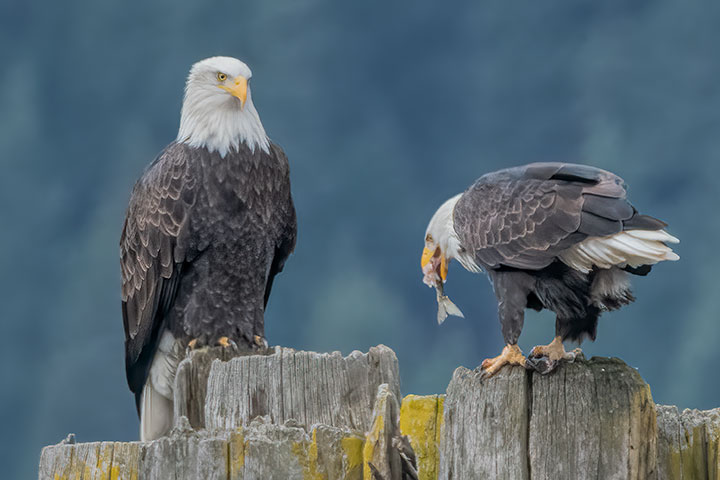
and leaves.