Tufted sparrow


Watch your surroundings long enough, and something distinctly odd may turn up — in this case a tufted sparrow. 

The bird is obviously a chick. It did not seem capable of flight and merely sat on the edge of a road. Two questions: What kind of bird is it? Why does it have antler-like feathery tufts extending from its head?

There have been really occasional sightings of tufted House Finch chicks, and a juvenile Chipping Sparrow, something my chick might be. However, I can find strikingly little information on such birds.

This tufted sparrow has confused me.


Posted in birds | 3 Comments

Unrelated cousins


We have grosbeaks: similarly looking, heavy-billed, seed- and insect-eating birds that have been lumped together as a group for over three centuries. They are, what is referred to as a form taxon, a group based, not upon their biology, but merely their appearances and behaviours.

In the past week, I have watched two grosbeaks: the Black-headed Grosbeak, which is a cardinal grosbeak, and the Evening Grosbeak, which is a grosbeak finch. These two are only distantly related. When seen in the pictures, they are clearly different, but when spotted in the field, I thought they were the same.

The Black-headed Grosbeak is a seasonal bird that is here in small numbers in the warm months. Its heavy bill is obvious.

Also relatively uncommon, the Evening Grosbeak might be seen at any time of the year.

Here the Evening Grosbeak poses for a contemplative portrait.


Posted in birds | 3 Comments

Lucy has a new gosling


Lucy was hatched at least a decade ago. She is the only local Canada Goose that is a recognizable individual. 

Normally, when we wish to identify an individual animal, we have to mark it with something ranging from a metal band, to an ear tag, or a tracking collar. This is because one individual looks much the same as the next (an exception being the humpback whale which is easily identified as an individual by the markings on the underside of its flukes). 

To our eyes, Canada Geese all look alike (with the males being slightly larger than females). Is the goose that visited today, the same one that visited yesterday, or last year? Who can tell?

However, Lucy is leucistic (thus, her name): some of the black feathers on her crown and nape lack pigment. She has been instantly recognizable as an individual since she was first spotted in 2012, already with a mate. Since then she has been seen a number of times along the West Arm, sometimes with chicks.  This morning, she was seen again along with her mate and a new chick.

Canada Geese are monogamous and can live for a couple of dozen years. Lucy may have a few more broods. 

Lucy (Goosey) is seen along the lakeshore with her mate and gosling.


Posted in birds, commentary | 4 Comments

More chicks


New life abounds in the spring. Here are three rarely featured species.

Robin
Four robin chicks look out from a nest under a building’s eves. 

One of the chicks seems to be getting more than its fair share of food.

Wild Turkey
A Wild Turkey mommy shelters her six chicks.

The chicks appear and disappear in the grass.

Black-capped Chickadee
The chicks of the Black-capped Chickadee look just like the adults. However, after fledging, the chicks are still being fed by adults. The chick on the right is begging for food.

And the adult responds by feeding it.


Posted in birds | Comments Off on More chicks

Vulture’s matutinal ritual


When one watches a Turkey Vulture’s morning, it certainly seems to reveal a ritualistic behaviour.

The day begins with the vulture spreading its wings to warm then in the early morning sunlight.

Then comes the obligatory stretching of the wings.

And the pooping.

There follows more stretching, while scanning the ground below for a possible breakfast.

It is time to head off and look for tasty carrion.

OK, this is going to take a bit more effort.


Posted in birds | 2 Comments

Mountain lady’s slipper


The mountain lady’s slipper is the third species of wild orchid found in Kokanee Creek Park this year. The earlier two were the fairy slipper and the striped coralroot.

A lone mountain lady’s slipper sits in the forest.


Posted in wildflowers | Comments Off on Mountain lady’s slipper

Big-chick feeding


There is a narrow window of opportunity to be able to see dipper chicks leaning out of their nest and being fed. When slightly younger, they stay inside; when slightly older they have fledged and are gone.

When I looked through my pictures of this event, something struck me as incongruous. The pictures of all the chicks showed them as apparently larger than the adults doing the feeding. How can this be?

I immediately thought about just-fledged juvenile eagles. They look bigger than the adults attending them only because the juvenile feathers are unworn and fluffed up. Then it dawned on me that in addition to the fluffy chick feathers, the dipper adult’s feathers were matted down from it having just swum underwater in the creek to retrieve the meal. So, the disparity in size makes sense, but it does look a bit odd.

Four dipper chicks lean out of their nest to beg for food.


Posted in birds | 5 Comments

Cedar Waxwings feed


Gregarious, garrulous, and guileless, a couple of dozen Cedar Waxwings feast on the petals of a black hawthorn tree. This is the first time I have seen a flock of these birds feeding on the petals of flowers. 

The Cedar Waxwing visits to breed here in the warm season. But, it also wanders about to feed.

One of the many Cedar Waxwings sits amidst its target blossoms of the black hawthorn tree.

As a bird depletes the petals at one spot, it quickly flies to another.

It seems that the thing being eaten is actually the petals of the blossoms.

And soon a bird is off to sample another blossom.


Posted in birds | 3 Comments

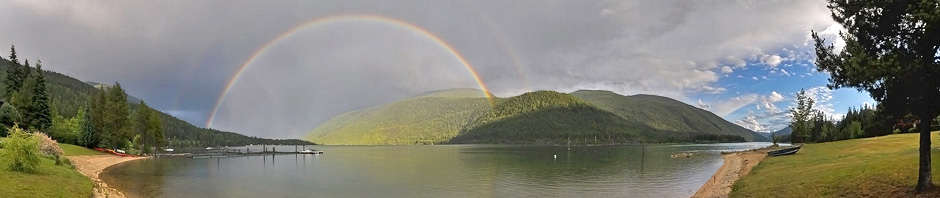
Rainbow


A nice characteristic of convective thunderstorms is that they tend to occur late in the day when the Sun is low in the sky. Sometimes, this results in rainbows.

A rainbow envelopes the peninsula of Kokanee Creek Provincial Park. 


Posted in weather | 3 Comments

Tiger Swallowtail


This is the time of year for visits from swallowtail butterflies — so I watch for them. We have a number of different swallowtail species, and I thought that, on subsequent days, I had spotted two different ones. However, when I examined my pictures, they all seemed to be the same species: a Canadian Tiger Swallowtail. I certainly am open to contrary suggestions as to the ID. 


Posted in bugs | 3 Comments