Blaze again


This is a good year for black bears in the valleys. Some years I see very few to none. This year, I have seen many. In particular, there is one bear in my neighbourhood that is easily recognized as an individual for it wears a blaze. 

A blaze is a common feature in eastern North American (or so I am told), but here it is rare enough to bestow individuality. Although not the only bear seen, this blaze-wearing bear has been a sometime resident for two months. 

As it searches for food around homes, it has evolved from favouring clover (a month ago) to feeding in cherry trees (now). 

The black bear was about five metres up a cherry tree. It wore the blaze on its chest. This is distinctly unusual in this region.

I watched the bear for a while, but towards the end it became uncomfortable with my presence and made a quiet huffing. (Huffing is a sound made by an apprehensive black bear. Huffing does not lead to an attack.) So, I drifted away and left it to eat cherries.


Posted in mammals | 1 Comment

Iridescent cloud


Yesterday, at about noon, there were wave clouds in the sky. I was admiring these when the sun moved over slowly behind one. Then the most marvellous series of colours appeared close around the sun. 

The iridescent colours were very bright, normally too bright to look at and so are rarely noticed. However, by decreasing the camera’s exposure, I was able to capture a bit of it.


Posted in weather | 10 Comments

Deer moult


This posting was prompted by the scruffy-looking female mule deer that was feeding on clover in the picture on the right.

There was something odd about it. Her body is adorned with whitish splotches. Yet, it seemed too early in the year and she seemed too big for this to be the result of the spots displayed by fawns.

Better look at a side view.

This is a moult pattern. The orange is the summer pelage; the white is what is temporarily left over from the winter. But, that pelage is dark, not white. What is going on?

I have seen the same pattern on a male white-tailed deer and even posted about it. As the same thing seems to be going on with the white-tailed and the mule deer, I will use white-tailed deer to explain what I know.

In the summer, deer wears a orangish pelage for camouflage. Now, humans clearly see an orange deer against a green background. But, that is not the case for all animals. Deer have two colour receptors (at the long wavelength end) and don’t see the difference between orange and green; they both look a neutral grey. So, the deer thinks it blends in with its background. But more to the point, the principal predators, coyotes and wolves, have the same deficiency and see orange and green as shades of grey. This is actually a good summer camouflage for deer.

However, moulting is a fact of life for deer that must renew its fur and the winter brings a duller brownish shade which blends in with the colourless surroundings. It also provides more insulation, for in winter there is an undercoat of (what are called) guard hairs.

There is a remaining problem. The spring moulting shows the orangish pelage, but with flaky whitish patches. I think these patches are the underneath guard hairs of winter, which vanish in the summertime. Is that the colour of the guard hairs? I cannot determine this, but this one picture of a winter deer with claw marks from a cougar suggests that the underfur is that colour.

So, both deer species go through a spring moult at this time whereby the pelage looks orange with white streaks.


Posted in mammals | 3 Comments

Black bear cub


I was close.


Posted in mammals | 3 Comments

Evening Elk Herd


Photographer: In exemption of the first, by Cynthia Fraser, the photos here are taken by Finn Fraser Grathwol. More of Finn’s photos can be seen at @finnfrasergrathwolphoto on instagram.

In the late evening (read: very low shutter speeds and blurrier photos) on the way back from Arrow Lakes on Canada day, we (myself, my dad, and Cynthia) came across a herd of 15-20 Rocky Mountain Elk, the local subspecies, by the side of the highway. Judging by the antlers, the herd appears to be almost exclusively comprised of females and 1-2 year old young males, referred to as cows to bulls, respectively.

Below, courtesy of Cynthia Fraser, a larger-scale sample of this herd is pictured, including a few month old calf. 

Here, a mother and her son pose for a family portrait. 

Two males; note the difference in antler length – perhaps signifying a slight age difference.

A different male rests — or rather uses his mother for a chin rub — it is unclear what behaviour is being exhibited. 

A young male elk times his obligatory nose cleaning perfectly with my camera’s shutter. 


Posted in mammals | 1 Comment

Cavity congestion


Tree Swallows nest in holes made by others such as woodpeckers or man. Both parents help to feed their youngsters. This is the breeding season which means that there is great deal of coming and going. Often one parent must wait at the entrance with a mouth full of food, while the other completes its feeding inside.

The parent (male?) with a mouthful of insects has waited by the cavity opening. As the other parent (female?) climbs over it, the male leans back, moves the nictitating membrane over its eyes, and clamps its bill tightly closed on the insects (although some bristles stick out). Stepping on the male’s head as it leaves, the female continues on its way to fetch more food.


Posted in birds | 2 Comments

June’s goulash


This is a collection of June’s pictures that lacked a posting of their own. 

June began with a dipper feeding a bug to one of it three chicks.

This purple virgin’s-bower (Clematis occidentalis) is a western flower. If one asks an app, it is often said to be a purple clematis, which is actually only found from Ontario east. Photograph by Cynthia Fraser.

This is a catbird singing. The striking thing is that the catbird (which does have a mew call) also mimics the calls of many other species and sings their songs.

The Great Blue Heron occasionally stands with its wings spread like a balalaika as it faces the sunlight. It is baking its parasites. Further evidence of this is its extended neck and its panting as it attempts to keep the blood cool that reaches its brain.

The Black-chinned Hummingbird is well-named: it has a black chin, indeed it whole head is black. Of course with the right angle of the light…

…the black chin can turn purple. The chin is iridescent and can be used to send signals.

There are three species of garter snakes in the province: the common, the western terrestrial, and the northwestern. I believe that this is the Northwestern Garter Snake. Photograph by Cynthia Fraser.

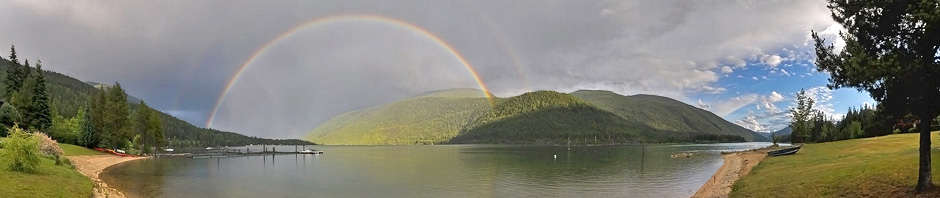
June ended with a double rainbow.


Posted in birds, herptiles, weather, wildflowers | 4 Comments

Crab spider


The hover fly is an innocent little fly, and with the advent of warm weather, there are a number of them about doing what they do: pollinate flowers. Not all creatures view them so benignly.

A few hover flies were pollinating daisies. 

But, one of those flowers contained a crab spider. Bye-bye hover fly.


Posted in bugs | 1 Comment

Merganser and fish


There are many mergansers on the Lake. Mergansers eat fish. But catch a merganser downing a fish. Lots of luck with that one. It happens very fast. The last time I succeeded with that was seven years ago.

A male Merganser tips his head back and swallows a fish whole.


Posted in birds, fish | 6 Comments

Two more wild orchids


On June 9th I posted two local wild orchids: the fairy slipper and the lady’s slipper. Each stalk had but one flower. Here are two more local wild orchids, but here the stalks contain many flowers: they are racemes.

Each of the today’s two wild flowers is a coral root characterized by the coral-like appearance of the underground rhizome. There are three species of this type of orchid around the lake. These two were found in Kokanee Creek Park (as were the slippers posted earlier).

This small plant is a spotted coral root. The growth of the flowers from the bottom to the top of the stalk is obvious in this shot. The top three flowers are about to come out.

This picture shows two stalks of the striped coral root orchid with a few of the flowers in the two racemes.


Posted in wildflowers | 2 Comments